
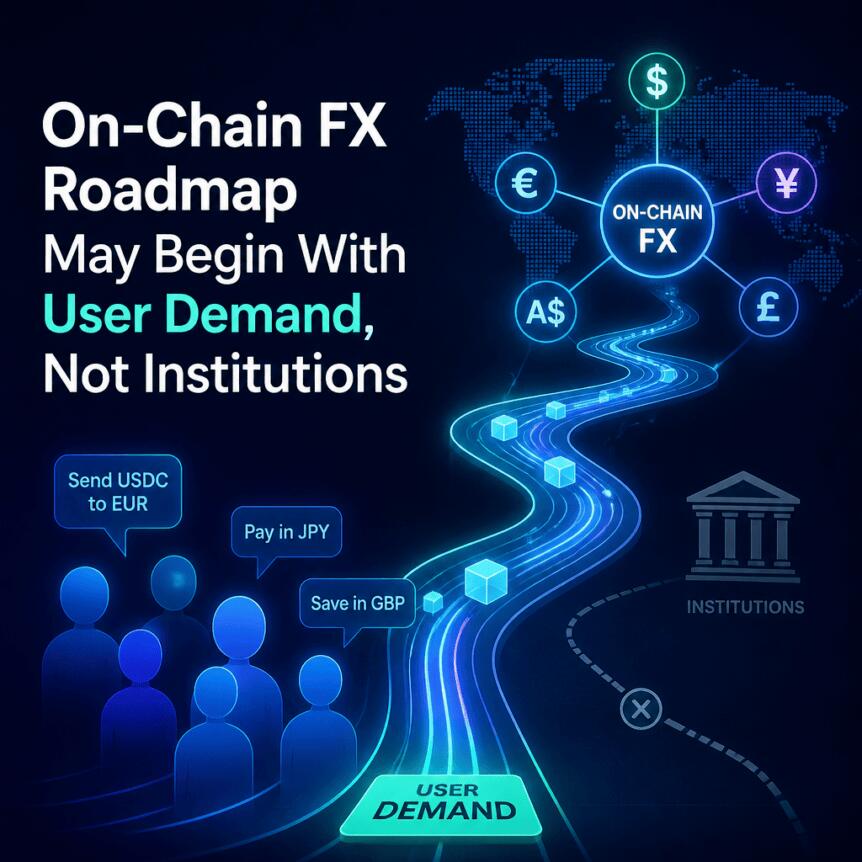
Onchain foreign exchange (FX) is often framed as something that will eventually mirror traditional markets—first enabled by large institutions, then scaled upward as liquidity thickens. But an alternative trajectory is starting to look more plausible: onchain FX may grow from practical, smaller user needs toward broader market structure.
In an opinion piece, Michael Egorov—founder of Curve Finance and Yield Basis—argues that stablecoin-based exchanges between fiat currencies can create the building blocks of onchain FX without waiting for bank-scale liquidity. His point is not that crypto will replace global FX overnight, but that usable markets can emerge when real demand exists and liquidity can be sustained by market design.
Key takeaways
- Onchain FX can develop “bottom up” as stablecoins are redeemed and moved quickly between digital wallets and bank accounts.
- Small pools are still economically useful if there is consistent demand for specific currency exchanges, even in low-volume ranges.
- DEX-based swaps can be faster and cheaper than some traditional bank transfers when users already hold value on-chain.
- Liquidity is the real constraint—not just demand—and automated market maker (AMM) mechanics may be better suited to sustain smaller FX markets.
- Banks are likely to remain key for entry/exit into fiat, while onchain infrastructure reduces “in-between” steps once funds are already digital.
From institutional FX to stablecoin routes
Egorov starts from a long-standing assumption: the “natural” order for onchain FX is to begin with major financial players that tokenize currencies and move large volumes onto blockchain rails. In that view, institutional liquidity would gradually spill down to wider use.
Instead, he points to signs that stablecoin markets tied to emerging-market currencies may be building the other way. Stablecoins described in the piece—such as Brazilian Digital (BRZ) and Monerium’s EURe—can be redeemed on-chain and moved between digital wallets and bank accounts. That creates a direct bridge between crypto rails and fiat needs, while also generating measurable activity when DeFi users swap them across DEX liquidity pools.
The emphasis is on how markets form in real time around practical payment workflows. Egorov cites Keyrock data showing that the majority of onchain stablecoin trades linked to emerging market currencies fall within the $1,000 to $10,000 range. While that is modest compared with institutional FX volumes, he frames it as precisely the point: it suggests market growth oriented around actual users rather than large traders.
Why “small” liquidity can still matter
A common critique of onchain FX is that it cannot be truly useful without deep liquidity. Egorov argues that this framing misses an important reality: if users need to convert between currencies and there is enough demand to support execution, even smaller pools can serve real economic purposes.
He connects the argument to stablecoins’ own history. Stablecoins began as a niche crypto-native tool, yet have since expanded into broader financial infrastructure. To support the trajectory of demand, the piece references Chainalysis data stating that cross-border stablecoin activity jumped to over $220 billion by mid-2026—an almost 80% increase over the course of one year.
The implication for onchain FX is straightforward in Egorov’s view: if stablecoin usage keeps scaling due to ongoing demand, onchain FX built on similar infrastructure could follow a comparable pattern—starting with narrower use cases and expanding as liquidity becomes sustainable.
Users convert for speed and cost, not for market share
Egorov shifts from liquidity theory to user behavior. In his framing, onchain FX doesn’t need to compete with the entire global FX market in order to be valuable. What matters most is whether it can solve a problem for someone who already has funds on-chain.
For example, he notes that converting a USD stablecoin into a EUR stablecoin (or another alternative) on-chain can enable payments with relatively little friction. He also points to earlier Cointelegraph coverage that described stablecoin transfers as often faster and cheaper than classic international bank transfers—an angle that reinforces why the “size of the overall market” may be less relevant to end users than execution quality and total cost.
He further argues that the business case for fintechs and crypto-card providers is narrower than recreating the full institutional FX stack. If the product only needs to move customers’ funds between currencies efficiently, it can avoid rebuilding the entire TradFi pipeline. That matters because converting currency via card or payment rails can introduce additional costs; Egorov mentions that Visa or Mastercard processing fees are around 1%.
In contrast, when customer funds are already on blockchain rails, swapping one stablecoin for another can be done directly. Banks may still be central where fiat on- and off-ramps are required—such as issuing and redeeming local currencies and handling compliance—but Egorov’s thesis is that “in-between” steps can be reduced once the transfer is fully digital.
Liquidity economics: demand alone isn’t enough
Even with genuine demand, Egorov says onchain FX still faces a fundamental constraint: liquidity must be economically sustainable. The challenge is not simply to create a EUR/USD or CHF/USD pool, but to ensure that providing liquidity is worth the cost of operating capital and infrastructure.
He suggests that traditional market makers may be reluctant to serve smaller FX markets when volume does not justify operational expenses. Instead, automated systems—particularly AMMs—can alter the economics by supplying liquidity continuously through software rather than requiring a firm to actively manage every trade.
To illustrate, Egorov describes a scenario involving two “dollar” stablecoins, USDC and Tether (USDT). From a traditional exchange perspective, swapping one $1 stablecoin for another can look unexciting because both are designed to remain near $1. But if users still have a legitimate need to move between stablecoins, an AMM can offer a direct swap path. Fees paid to liquidity providers can, in theory, create a viable market even when the activity does not look attractive by conventional FX trading metrics.
The adoption curve, he acknowledges, is not likely to be explosive. However, he frames slow growth as a feature rather than a failure: new markets can emerge from small groups with recurring needs, and liquidity can expand once the economics work.
For investors, traders, and builders watching onchain FX, the next test is whether liquidity can remain sustainable as use cases broaden beyond the earliest stablecoin-to-stablecoin conversions, and whether AMM-driven structures can consistently support specific currency corridors with enough repeat demand.
https://www.cryptobreaking.com/on-chain-fx-roadmap-may/?utm_source=blogger%20&utm_medium=social_auto&utm_campaign=On-Chain%20FX%20Roadmap%20May%20Begin%20With%20User%20Demand,%20Not%20Institutions%20
Comments
Post a Comment