
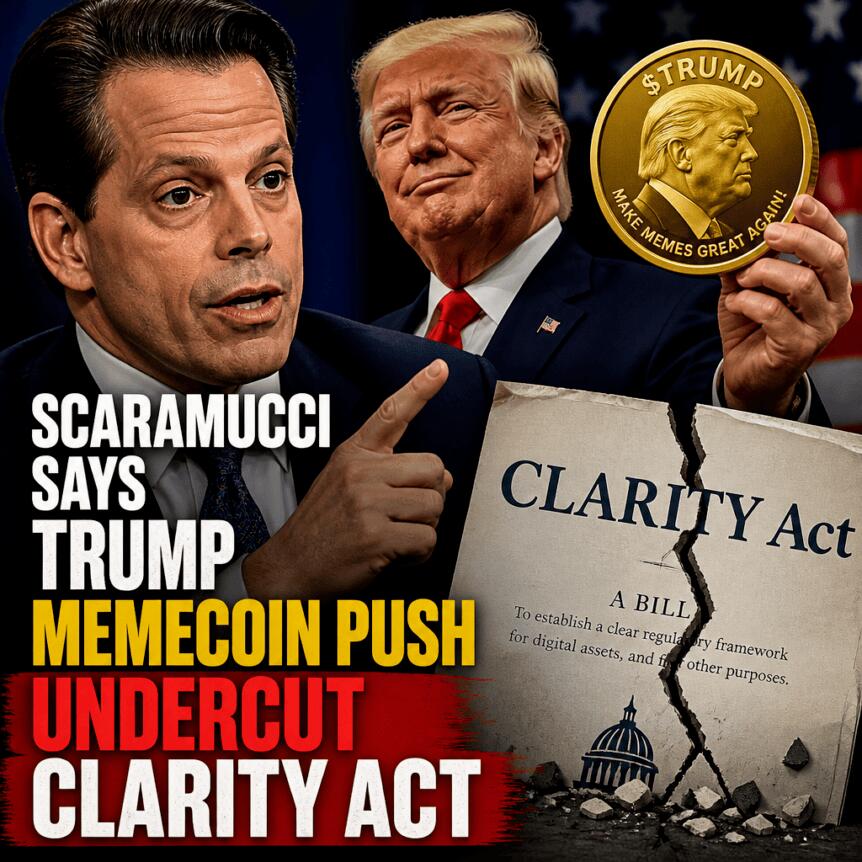
SkyBridge Capital founder Anthony Scaramucci argued that political and personal business entanglements around President Donald Trump helped stall the momentum behind the CLARITY Act—pointing specifically to memecoin activity that, in his view, weakened Democratic support for broader crypto regulation.
Speaking to Cointelegraph at SALT London, Scaramucci said memecoin launches shortly before Trump’s January 2025 inauguration undermined efforts to build bipartisan consensus after the 2024 election. He described the memecoin issue as the “singular reason” the bill failed to advance, while also noting that disagreements over ethics provisions were central to the breakdown.
Key takeaways
- Scaramucci attributes the CLARITY Act’s failure to the timing of Trump-linked memecoin launches before the January 2025 inauguration.
- He says Democrats who had become more receptive to regulation withdrew support following those launches.
- Scaramucci also argues negotiations broke down over how strict ethics rules for government officials should be.
- The Senate procedural vote on Sept. 15 fell short of the 60-vote threshold needed to move the CLARITY Act forward.
What derailed the CLARITY Act
The remarks come after the U.S. Senate failed to advance the CLARITY Act on Sept. 15. As reported by Cointelegraph, a procedural motion received 49 votes in favor and 50 against, short of the 60 votes required. The bill aimed to establish a federal regulatory framework for digital assets, but the effort was complicated by disagreements over ethics provisions designed to limit or restrict government officials’ crypto-related interests.
In Scaramucci’s telling, the political climate shifted at a critical moment. He said memecoin launches around the period leading up to the inauguration disrupted bipartisan momentum that might otherwise have carried the legislation farther through the legislative process.
When asked whether memecoin activity was the sole reason the bill did not pass, Scaramucci said “singular reason,” adding that Democrats who had shown greater openness to crypto regulation reversed course after the launches.
Ethics negotiations and the White House position
Scaramucci’s account goes beyond the memecoin narrative. He also pointed to a substantive legislative friction point: the push for stronger ethics restrictions and the alleged reluctance of the White House to sign off on that direction.
“I think it’s the business interests, the memecoins,” Scaramucci said, describing lawmakers as trying “to put real teeth into the ethics provision” while the White House “did not want to sign it.”
He framed the final outcome as a mutual failure to reach a workable deal, stating there was “culpability on both sides” for the legislation not moving forward.
Scaramucci’s emphasis on ethics illustrates how crypto regulation—especially measures that touch token issuance, trading, and investment structures—can become enmeshed in broader governance questions. Even when the technical goal is a clearer regulatory regime, the political pathway can hinge on credibility, conflicts of interest, and institutional trust.
Preceding concerns from Democrats and consumer advocates
Earlier reporting by Cointelegraph highlighted that lawmakers and advocacy groups had already been focused on potential conflicts involving Trump’s crypto footprint. In July, five Democratic senators called for hearings into Trump’s crypto holdings and possible conflicts of interest, citing concerns that financial ties could influence crypto policy. Around the same period, House Financial Services Committee Chair French Hill acknowledged that Trump’s crypto businesses had complicated attempts to pass legislation.
Later, consumer advocacy group Public Citizen estimated that investors incurred at least $4.7 billion in largely unrealized losses across Trump-related crypto ventures, including $3.2 billion tied to the Official Trump memecoin. The group also said Trump earned $635 million in memecoin licensing fees in 2025, citing his financial disclosure, according to Cointelegraph.
Taken together, those threads suggest the CLARITY Act dispute was not occurring in isolation. For many observers, the question was not only how to regulate digital assets, but whether the political process could credibly separate crypto policy from personal financial incentives.
Where token regulation may still move: SEC focus on tokenization
Despite the legislative setback, Scaramucci argued that regulatory progress could still come from the executive-branch side, particularly through the Securities and Exchange Commission. He said the SEC’s approach under Chair Paul Atkins could help tokenization reach what he described as “escape velocity”—a threshold where adoption becomes widespread enough that it becomes harder for future SEC leadership to halt or significantly slow the industry.
He cautioned that it was too early to know whether the level of adoption needed for that outcome would materialize before the next administration. That uncertainty matters for market participants because the regulatory bottleneck may shift: if legislation stalls, the pace of industry compliance and product development can increasingly depend on enforcement posture, interpretive guidance, and agency priorities.
For readers tracking U.S. crypto policy, the next signals to watch are whether lawmakers revisit the CLARITY Act framework with revised ethics language, and whether SEC actions continue to support tokenization without triggering broader political pushback. The balance between legislative clarity and executive-branch enforcement could decide whether the industry gets a stable runway—or remains stuck in cycles of partial progress and renewed uncertainty.
https://www.cryptobreaking.com/scaramucci-says-trump-memecoin-push/?utm_source=blogger%20&utm_medium=social_auto&utm_campaign=Scaramucci%20Says%20Trump%20Memecoin%20Push%20Undercut%20CLARITY%20Act%20
Comments
Post a Comment