
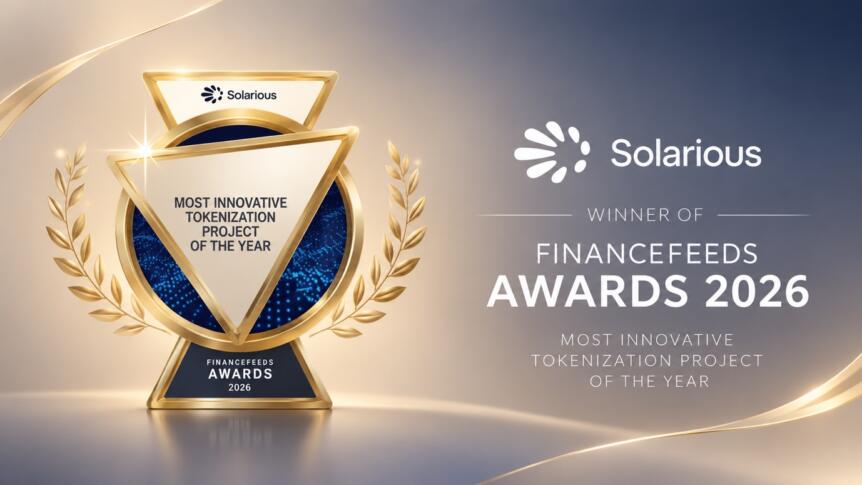
Solarious has received the “Most Innovative Tokenization Project of the Year” award at the FinanceFeeds Awards 2026, marking an important milestone for the project as it develops blockchain infrastructure connecting real-world renewable energy production with the digital asset economy.
The recognition comes from FinanceFeeds, an independent financial industry publication covering global trading markets, fintech, brokerage technology, and digital assets. Through its annual awards program, FinanceFeeds highlights companies and solutions contributing to innovation across financial services, blockchain, cryptocurrency, and emerging technologies.
For Solarious, this distinction highlights the growing relevance of a new approach to real-world asset (RWA) tokenization: connecting blockchain activity not simply to existing financial assets, but to measurable physical processes such as renewable electricity generation.
FinanceFeeds Awards 2026: Recognizing Innovation Across Financial Technology
The FinanceFeeds Awards bring together companies operating across retail and institutional trading, brokerage services, fintech, payment infrastructure, and the cryptocurrency and blockchain sectors.
The awards program features a range of industry-specific categories and evaluates companies through an expert-led judging process. According to FinanceFeeds, its judging panel includes members of the publication's senior editorial team alongside invited independent industry professionals. The evaluation process includes independent scoring of nominations and confidential voting.
This makes the recognition particularly relevant for companies developing new technologies and business models within the financial and digital asset industries.
Solarious was selected in the “Most Innovative Tokenization Project of the Year” category, highlighting its approach to bringing renewable energy infrastructure and blockchain technology together.
A Different Approach to Real-World Asset Tokenization
Tokenization is increasingly becoming an important part of the evolution of digital finance. While many projects focus on real estate, financial instruments, commodities, and other established asset classes, Solarious is exploring another opportunity: renewable energy.
The project's concept is built around transforming measurable solar electricity production into verifiable digital records that can form the foundation for new blockchain-enabled applications.
At the center of this ecosystem is its proprietary Layer-1 blockchain architecture, powered by Proof-of-Energy (PoE). This framework is designed to establish a verifiable relationship between actual energy generation and blockchain network activity.
Rather than relying exclusively on conventional consensus mechanisms, Solarious aims to incorporate real-world energy production data into its verification infrastructure.
Through its Solar Miner hardware, the project intends to collect electricity generation information from connected solar installations, generate cryptographically signed records, and submit them for network validation.
This creates a framework in which physical energy production can become a measurable and verifiable component of digital infrastructure.
Turning Renewable Energy Data Into Digital Value
One of the most interesting opportunities in the renewable energy sector extends beyond electricity generation itself.
Solar installations can also produce environmental attributes that may qualify for Renewable Energy Certificates (RECs) or Solar Renewable Energy Certificates (SRECs), depending on the applicable regulatory and certification frameworks.
Despite the growing importance of these markets, the processes involved in measuring, verifying, certifying, and settling environmental attributes can remain fragmented and administratively complex.
Solarious is developing infrastructure intended to connect verified energy production data with digital records and potential future settlement mechanisms.
Its long-term roadmap includes exploring blockchain-enabled applications for renewable energy certificates and environmental commodities, potentially helping create more transparent and accessible processes for market participants.
An important distinction within the ecosystem is that the native $SOLAR utility token and environmental certificates represent different components. The token supports the project's blockchain ecosystem, while certificate-related tokenization and settlement are separate development directions.
An Integrated Ecosystem: From Solar Hardware to Blockchain Infrastructure
Solarious is developing several interconnected components designed to support its broader vision for an energy-linked blockchain economy.
These include:
- Proof-of-Energy (PoE): A protocol designed to connect real-world energy generation with blockchain verification.
- Solar Miner: Hardware infrastructure intended to capture and transmit solar electricity production data.
- Validator Network: Infrastructure responsible for verifying submitted energy-related records.
- Verdex Wallet: A wallet component designed to support participation in the Solarious ecosystem.
- $SOLAR Token: The native utility asset supporting the project's blockchain environment.
By bringing these elements together, Solarious aims to establish an infrastructure layer connecting physical renewable energy assets with decentralized technology.
This approach distinguishes the project from tokenization models that primarily focus on representing ownership or financial claims over existing assets. Instead, Solarious starts with measurable physical activity and seeks to build digital verification and economic applications around it.
The Vision Behind Solarious
Commenting on the recognition and the project's long-term direction, Jack Samatov, CEO of Solarious, emphasized the importance of connecting blockchain technology with real economic activity:
“The future of tokenization is not limited to assets that already exist in financial markets. We believe the next major opportunity lies in connecting blockchain technology with measurable economic activity in the physical world. Renewable energy is one of the most compelling examples. At Solarious, our mission is to create the infrastructure that connects real energy production with transparent digital verification and new opportunities for economic participation.”
The FinanceFeeds Awards 2026 recognition represents an important milestone in the project's development and adds industry visibility to its work at the intersection of clean energy, blockchain infrastructure, and real-world asset tokenization.
As the Solarious ecosystem continues to evolve, its development roadmap focuses on expanding validator infrastructure, strengthening energy verification capabilities, and exploring new applications for environmental commodity settlement.
The broader ambition is to contribute to an emerging digital energy economy in which renewable electricity production can be transparently measured, verified, and connected to new forms of economic participation.
Learn more about Solarious and its ecosystem at solarious.us.
https://www.cryptobreaking.com/solarious-wins-financefeeds-awards-2026/?utm_source=blogger%20&utm_medium=social_auto&utm_campaign=Solarious%20Wins%20FinanceFeeds%20Awards%202026%20for%20Innovation%20in%20Renewable%20Energy%20Tokenization%20
Comments
Post a Comment