
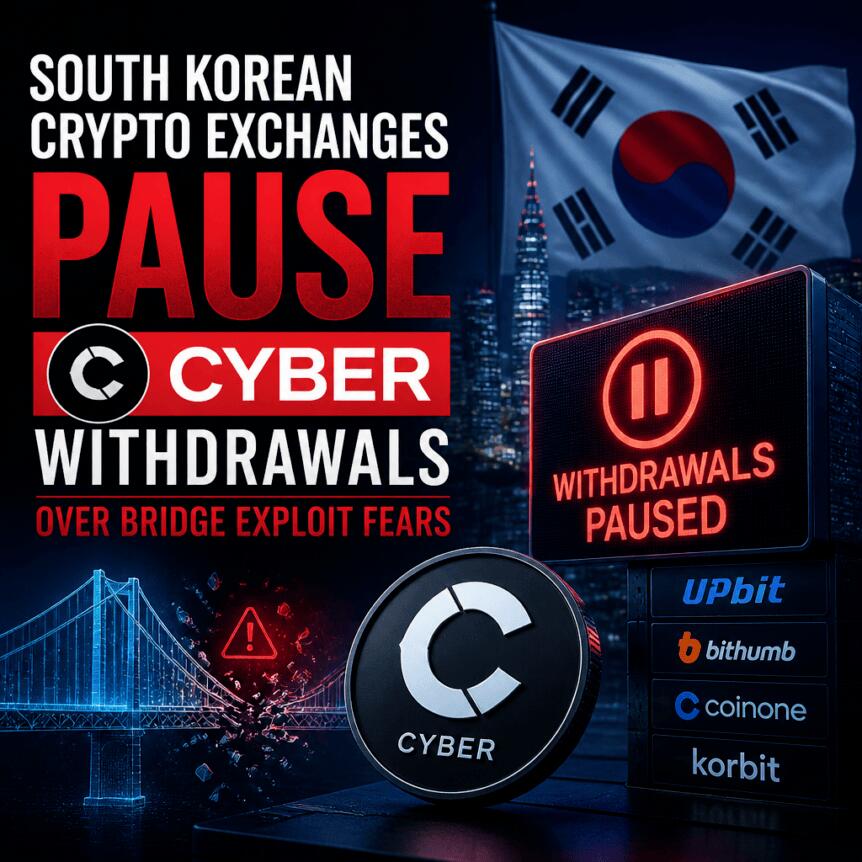
South Korean exchanges Upbit and Bithumb have temporarily suspended deposits and withdrawals of CYBER after the project behind the token reported suspicious activity tied to its cross-chain bridge. Trading on the exchanges is continuing, but users are being blocked from moving funds to and from the platforms while network and bridge stability are assessed.
In separate notices, Bithumb said it detected “suspected security issues” connected to CYBER transfers, while Upbit announced a temporary suspension of CYBER deposits and withdrawals. Both exchanges framed the move as a precaution until the underlying situation is clarified, and both implied that normal transfers could resume once stability is confirmed.
Key takeaways
- Bithumb and Upbit have paused CYBER deposits and withdrawals following the project’s report of bridge-related suspicious activity.
- CYBER trading remains enabled for now, suggesting exchanges are prioritizing liquidity continuity while limiting transfer risk.
- Cyber says it observed unexpected token minting on Solana and subsequent token movement out of an Ethereum “lockbox” tied to its bridge.
- The broader regulatory backdrop in South Korea includes plans to allow exchanges to halt withdrawals and deposits when hacking is suspected, not only after confirmed breaches.
Exchanges halt CYBER transfers amid bridge concerns
Bithumb announced the suspension of CYBER deposits and withdrawals on Sunday, citing suspected security problems. The exchange stated that trading will continue, and that withdrawals and deposits would be reinstated once “network stability” is assured, according to the notice published by Bithumb.
Upbit issued a similar temporary measure, suspending CYBER deposits and withdrawals as well. Like Bithumb, Upbit positioned the pause as temporary, leaving open the possibility of resuming transfers once the project’s incident response and technical checks indicate it is safe to do so.
For users, the practical impact is straightforward: even if CYBER can be bought and sold on the exchanges, the routes into and out of the platform are currently constrained. For traders who rely on getting exposure without holding inventory on an exchange, this can affect execution timelines and risk management, particularly when cross-chain bridges and mint/burn mechanisms are under investigation.
What Cyber says happened: minting on Solana and movement from an Ethereum lockbox
The incident trace begins with the project itself. On Saturday, Cyber stated that it detected unexpected minting of CYBER tokens on Solana. It further said those tokens were then transferred out of its bridge’s Ethereum lockbox.
Cyber—formerly CyberConnect—runs an Ethereum layer-2 network focused on social applications. In its public statement, the project said it is investigating the incident and determining which assets and bridge routes may have been affected.
Importantly, Cyber also advised users to avoid using the bridge and to refrain from depositing CYBER to exchanges while the investigation continues. That guidance aligns with the exchanges’ actions: if the bridge’s accounting or custody controls are under scrutiny, deposits and withdrawals can become the weak link even when trading markets remain open.
Why suspensions are being used now: South Korea’s shift toward earlier action
The current episode also reflects an evolving regulatory and operational posture in South Korea. Days earlier, the Financial Services Commission (FSC) announced plans to allow exchanges to halt deposits and withdrawals when hacking is suspected, rather than waiting for a confirmed breach.
This matters because bridge incidents can be difficult to verify quickly. Minting events, custody movements, and route anomalies may be detectable on-chain or through monitoring systems, but proving impact across all possible paths can take longer. Allowing “suspected” incidents to trigger exchange-level transfer freezes gives platforms a way to reduce the risk of confirmed losses while investigations run.
The effect is not purely theoretical. Earlier in November, South Korean exchange GOPAX suspended crypto trading, deposits, and standard withdrawals after receiving a hacking threat, even while GOPAX said no breach had yet occurred. That pattern suggests that South Korean exchanges may increasingly treat credible threat signals—whether from project teams or monitoring systems—as enough to justify partial operational pauses.
What investors and users should watch next
The most immediate question is whether CYBER’s bridge-related controls can be validated as secure and consistent across the relevant routes. Cyber said it is assessing which assets and bridge routes were affected, but it did not specify in the available report what the final scope will be or when that determination will be completed.
For market participants, two things are likely to influence next steps. First, exchange transfer suspensions are usually reversed only after the project and network operators can demonstrate stability and reduce the risk of further compromised transfers. Second, the on-chain mechanics behind “unexpected minting” and the Ethereum lockbox custody need to be understood—if the anomaly traces to specific routes, the fix may allow targeted recovery without requiring broader restrictions for all tokens and networks.
Readers should also pay attention to any follow-up from Cyber regarding the bridge routes under review and whether it provides timelines for resuming bridge usage and exchange deposits/withdrawals. Until then, the key operational reality remains: CYBER trading may continue on South Korean venues, but moving funds across platforms is likely to stay restricted while the incident is investigated.
https://www.cryptobreaking.com/south-korean-crypto-exchanges-pause/?utm_source=blogger%20&utm_medium=social_auto&utm_campaign=South%20Korean%20Crypto%20Exchanges%20Pause%20CYBER%20Withdrawals%20Over%20Bridge%20Exploit%20Fears%20
Comments
Post a Comment