
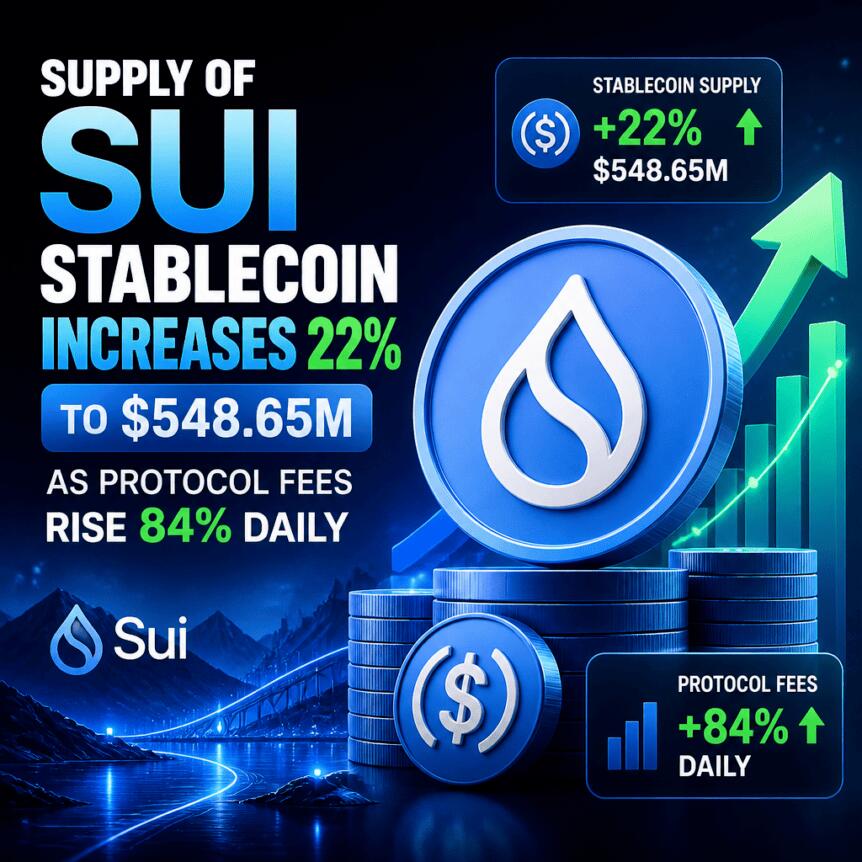
The supply of dollar-backed tokens within Sui’s stablecoin market neared $550 million within the first 13 days of November. This expansion stands out despite weaker performance in the broader cryptocurrency market, suggesting sustained growth in dollar-denominated liquidity on the network.
According to figures shared by CertiK Skynet on X, Sui’s stablecoin supply rose from $449.84 million on November 1 to $548.65 million on November 13. The increase totaled approximately $98.81 million, or 22%, over the reporting period.
The surge was most pronounced in the first week of November, when the supply reached the $500 million mark by November 3. It moved above $520 million on November 5, then continued climbing to nearly $550 million by November 7.
However, the increase was not consistent throughout the period. From November 8 to November 10, the supply fluctuated between roughly $530 million and $540 million. Another jump followed, taking the supply to near $550 million by November 11. On November 13, the supply stood at $548.65 million, slightly below the recent high point.
Increasing Stablecoin Supply Enhances Network Liquidity
An increase in stablecoin supply on Sui adds another factor that can support higher activity levels on the network. Stablecoins are designed to hold their value, often through a fixed ratio to the US dollar.
This can strengthen blockchain use cases such as transactions, transfers, trading, and participation in decentralized finance applications. As stablecoin circulation expands, liquidity across the network may improve.
That said, higher circulation does not automatically translate into higher transaction volume. Some stablecoins may remain idle in wallets, while others are used across decentralized applications and exchanges.
Therefore, transaction volume and other metrics should also be considered when assessing how efficiently liquidity is being utilized.
Daily Protocol Fees Rise 84% To About $150,000
Alongside the stablecoin supply increase, Sui also saw higher daily protocol fees. CertiK Skynet reported that the indicator rose 84% to roughly $150,000 over the analyzed period.
Protocol fees provide another lens for understanding how active blockchain networks and their applications are. This increase suggests higher network usage fees during the observed period.
Taken together, the rise in stablecoin supply and the increase in protocol fees highlight two different sides of Sui’s ecosystem: dollar-pegged liquidity on one hand and the cost of network activity on the other. Still, neither indicator alone proves broader economic activity.
Sui November Growth Faces A Sustainability Test
Sui’s latest data points to steady growth in its stablecoin economy despite challenging conditions in the crypto industry.
Whether this trend continues will largely depend on what happens in future reporting periods. Steady stablecoin growth, along with higher protocol fees, may help explain the network’s recent strong performance.
At the moment, the stablecoin supply reaching $548.65 million and the 84% jump in daily protocol fees have put Sui’s liquidity and activity in focus.
https://www.cryptobreaking.com/supply-of-sui-stablecoin-increases/?utm_source=blogger%20&utm_medium=social_auto&utm_campaign=Supply%20Of%20Sui%20Stablecoin%20Increases%2022%%20To%20$548.65M%20As%20Protocol%20Fees%20Rise%2084%%20Daily%20
Comments
Post a Comment