
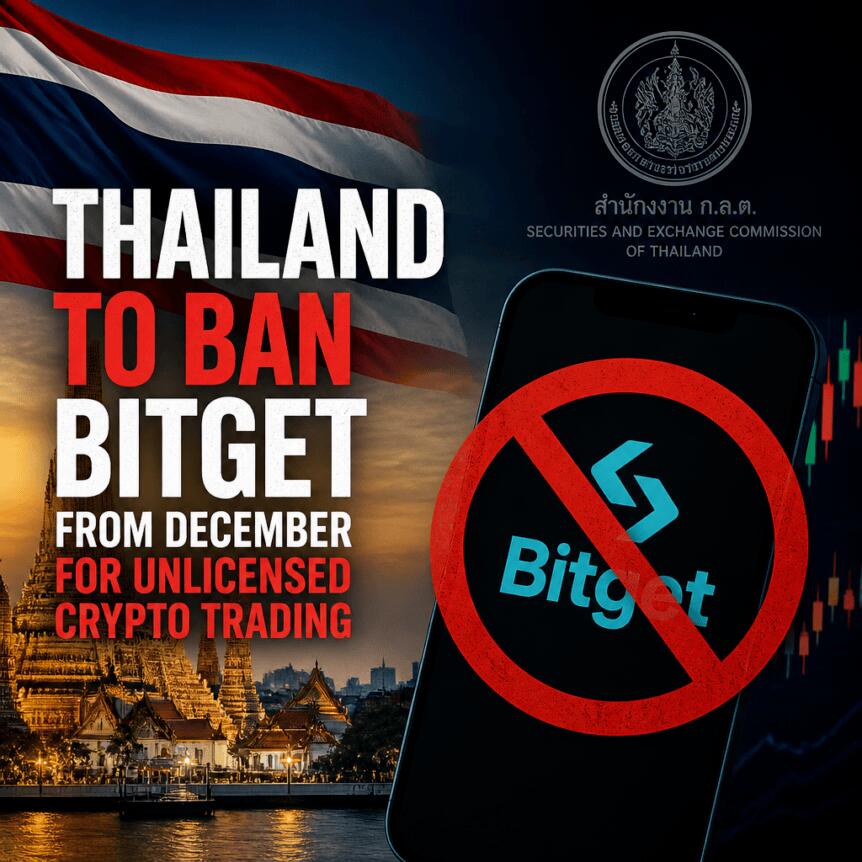
Thailand’s securities regulator has escalated its crackdown on unlicensed crypto trading by filing a criminal complaint against BG Limited, the company behind the Bitget exchange. The Thai SEC says Bitget operated in Thailand without complying with the country’s licensing rules, prompting both legal action and an impending access restriction.
In a notice issued Thursday, the Thailand Securities and Exchange Commission (SEC) said it has informed the Ministry of Digital Economy and Society to block access to Bitget starting Dec. 5. The restriction is intended to cover Bitget’s website, related domains, and its mobile application, with the regulator urging users to review and manage any crypto assets they hold on the platform before the deadline.
Key takeaways
- Thailand’s SEC has filed a criminal complaint against BG Limited (Bitget) for allegedly providing crypto trading services without the required license.
- The SEC says it notified Thailand’s Ministry of Digital Economy and Society to block Bitget’s website, domains, and mobile app from Dec. 5.
- The SEC alleges Bitget’s Thailand-targeted marketing and fee-taking activity took place between 2022 and 2025.
- Thailand’s rules were broadened in April 2025 to explicitly cover foreign platforms seeking Thai customers, strengthening authorities’ ability to block access.
- The case arrives shortly after Bitget announced plans to acquire a licensed Thai exchange, underscoring how enforcement can proceed even amid expansion efforts.
Thailand SEC moves from warnings to criminal proceedings
According to the Thailand SEC, Bitget offered crypto trading services in Thailand from 2022 through 2025. The regulator also pointed to trading fee collection and promotional activity directed at Thai users, including through Thai-language websites and social media channels. The SEC’s core claim is that these actions violated Thailand’s digital asset business licensing requirements.
The regulator said it submitted the criminal complaint to the Economic Crime Suppression Division for investigation. Prosecutors will determine whether formal charges should be brought, while the courts will ultimately decide on criminal responsibility.
Under Thailand’s framework, the Ministry of Digital Economy and Society has authority to restrict access to unlicensed crypto trading platforms. The SEC’s announcement references a 2025 decree aimed at protecting investors and combating financial crime, which the regulator says supports the planned access block.
Why the SEC’s 2025 rule changes matter
Thailand has been building a licensing approach for crypto exchanges for several years. The SEC previously introduced its first crypto exchange licensing framework in 2018. However, the regulator said the relevant rules were tightened in April 2025 to explicitly address foreign platforms targeting Thai users.
In particular, the April 2025 amendments reportedly expanded enforcement powers, including the ability for authorities to block access to exchanges operating without the appropriate license. The SEC’s current action fits that enforcement posture: it pairs a criminal complaint with a planned platform-wide access restriction.
For market participants, the implication is straightforward: marketing or service availability to Thai residents may be treated as sufficient to trigger Thailand’s licensing expectations—even when a platform is not physically based in the country.
Bitget’s planned acquisition does not appear to stop enforcement
The SEC’s complaint comes in close proximity to Bitget’s earlier announcement about strengthening its licensed presence in Thailand. More than two weeks before the SEC’s Thursday statement, Bitget said it planned to acquire GMO-Z.com Cryptonomics, a locally licensed crypto exchange and brokerage, through its affiliate BTGT Management.
Bitget disclosed the proposed acquisition on Oct. 20, noting at the time that the deal remained subject to regulatory approval. The exchange said it intended to introduce its trading platform to Thai users after completing the transaction. The SEC’s latest enforcement step—filed while that process was still unfolding—suggests that regulator action is not necessarily paused by plans to obtain local licensing.
This matters for investors and users because it highlights a key timing risk: even if a platform intends to become licensed, regulators may still treat earlier unlicensed activity as independently actionable. Users considering whether to remain on an unlicensed platform may want to factor in the possibility of rapid access restrictions once investigations advance.
The SEC also named Kritsana Kritsananuwat in its complaint. The regulator accused him of helping promote Bitget through Facebook and YouTube, allegedly drawing potential customers to the exchange. The SEC previously accused the same individual of promoting OKX without a license in March 2025.
What users should watch next
For now, the most immediate development is procedural: prosecutors will decide whether to pursue charges following the SEC’s complaint, and Thailand’s courts will ultimately determine criminal liability. At the same time, users are expected to plan around the Dec. 5 deadline for Bitget access restrictions.
Beyond the case itself, the broader signal to the market is that Thailand’s tightened 2025 rules on foreign platforms are being actively used—potentially changing how exchanges evaluate compliance and go-to-market strategy for Thai users.
https://www.cryptobreaking.com/thailand-to-ban-bitget-from/?utm_source=blogger%20&utm_medium=social_auto&utm_campaign=Thailand%20to%20Ban%20Bitget%20From%20December%20for%20Unlicensed%20Crypto%20Trading%20
Comments
Post a Comment