
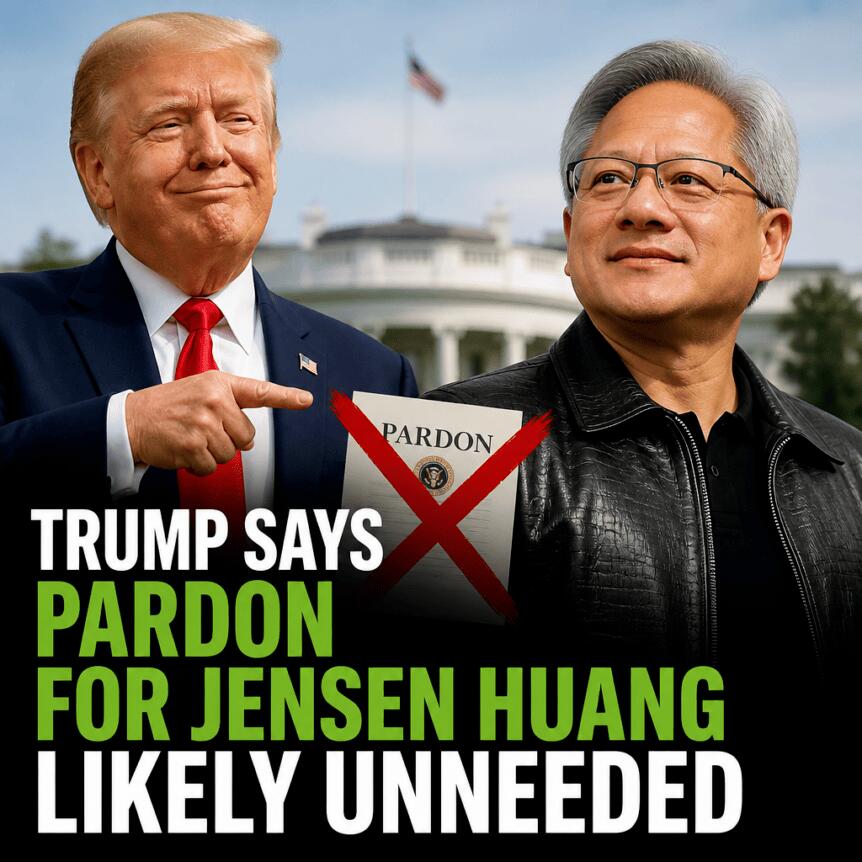
U.S. President Donald Trump said he is “always” open to the possibility of pardoning Nvidia founder and CEO Jensen Huang, but added that he does not expect it to be necessary. The remarks came in an interview with the New York Post shortly after Huang was reinstated as Nvidia’s CEO.
Huang’s return follows renewed scrutiny over allegations that he had an affair with a suspected Chinese spy, and questions about whether Nvidia chips could end up in China amid U.S. technology and export-control concerns. While the president’s comment keeps a pardon on the table, it also places Huang’s upcoming congressional appearances in sharper focus for investors and anyone watching the geopolitics of semiconductors.
Key takeaways
- Trump told the New York Post that a pardon for Jensen Huang is “an option,” but he “doesn’t think it’ll be necessary.”
- Huang was reinstated as Nvidia CEO just a day before the interview, after board action associated with the unfolding investigation.
- Huang is scheduled to participate in closed-door, transcribed testimony with multiple House committees on Dec. 1.
- He is also set to be the sole witness in a Senate hearing on Dec. 3 focused on U.S. export controls.
Trump leaves pardon door open as Nvidia faces scrutiny
In the New York Post interview, Trump was asked about the prospect of a pardon in connection with any potential crimes. He responded that it would always be an option, while stressing he does not believe it will be needed.
The president’s comments arrive amid a politically sensitive backdrop for Nvidia. The report notes that Huang’s reinstatement comes as scrutiny continues over allegations involving his personal life and possible intelligence-related implications, alongside concerns about whether the company’s high-end chips could be diverted to or effectively accessed by China.
For markets, the key point is less the pardon itself and more what it signals about the U.S. approach to this type of controversy—especially when it intersects with national security and export policy. Even without additional legal details in the article, the timing underscores that regulatory and congressional pressure is still expected to play out through formal testimony.
Reinstatement follows earlier political claims tied to the Nvidia board
The New York Post report states that Trump previously claimed he pushed Nvidia’s board to reinstate Huang. It also says Nvidia’s stock rose on Monday following the board’s move, highlighting how quickly investor sentiment can shift when leadership and governance questions are resolved—at least temporarily.
That matters because leadership decisions at major semiconductor firms are often treated as proxies for stability in compliance, government relations, and supply-chain risk. If congressional scrutiny continues to intensify, investors may look to reinstatement as a sign that the company expects to remain able to operate within U.S. policy boundaries—even as hearings proceed.
Still, Trump’s “option” framing suggests that the situation remains fluid. Investors should treat reinstatement as a management development, not a final legal or regulatory resolution.
Huang’s congressional schedule: House testimony first, Senate export controls next
According to the report, Huang is scheduled to testify before lawmakers in a closed-door, transcribed interview on Dec. 1. The testimony is set to involve the House Foreign Affairs Committee, the House Intelligence Committee, and the House Select Committee on the Chinese Communist Party.
That combination of committees is notable. It points to a broad sweep of issues—national security implications, foreign policy concerns, and China-focused oversight—rather than a narrowly defined technical inquiry. For investors and industry observers, it suggests lawmakers may be probing both the governance side (including how issues are handled inside a major technology company) and the geopolitical side (including how U.S.-origin technologies are used in markets of concern).
On Dec. 3, the article adds that Huang is set to be the sole witness in a hearing by the Senate Committee on Banking, Housing and Urban Affairs. The hearing is framed around U.S. export controls.
That shift—from multiple House committees covering intelligence and China-related oversight to a Senate hearing centered on export rules—could help shape how companies interpret enforcement priorities. Export controls are particularly sensitive in the semiconductor sector because they connect corporate strategy to compliance obligations, licensing pathways, and the realities of global demand.
What to watch as testimony could clarify export-control risk
Trump’s comments do not, by themselves, resolve the underlying questions about how Nvidia chips may be distributed or used amid U.S. restrictions. The decisive information is likely to emerge from testimony, especially given the report’s emphasis on Huang being the sole witness in the Senate export-controls hearing.
Readers should watch for whether congressional questioning concentrates on specific compliance mechanisms, supply-chain controls, licensing outcomes, and how the company assesses where advanced chips ultimately go. The testimony will also be a test of how Huang, as the reinstalled CEO, positions Nvidia to manage both political scrutiny and regulatory expectations.
For now, the most concrete timeline is already set: Dec. 1 closed-door House testimony, followed by Dec. 3 Senate testimony focused on export controls. Until more details come to light, Trump’s “pardon” remark remains less a legal milestone than a signal of continuing high-level attention to this case at the intersection of technology, security, and geopolitics.
https://www.cryptobreaking.com/trump-says-pardon-for-jensen/?utm_source=blogger%20&utm_medium=social_auto&utm_campaign=Trump%20Says%20Pardon%20for%20Jensen%20Huang%20Likely%20Unneeded%20
Comments
Post a Comment