
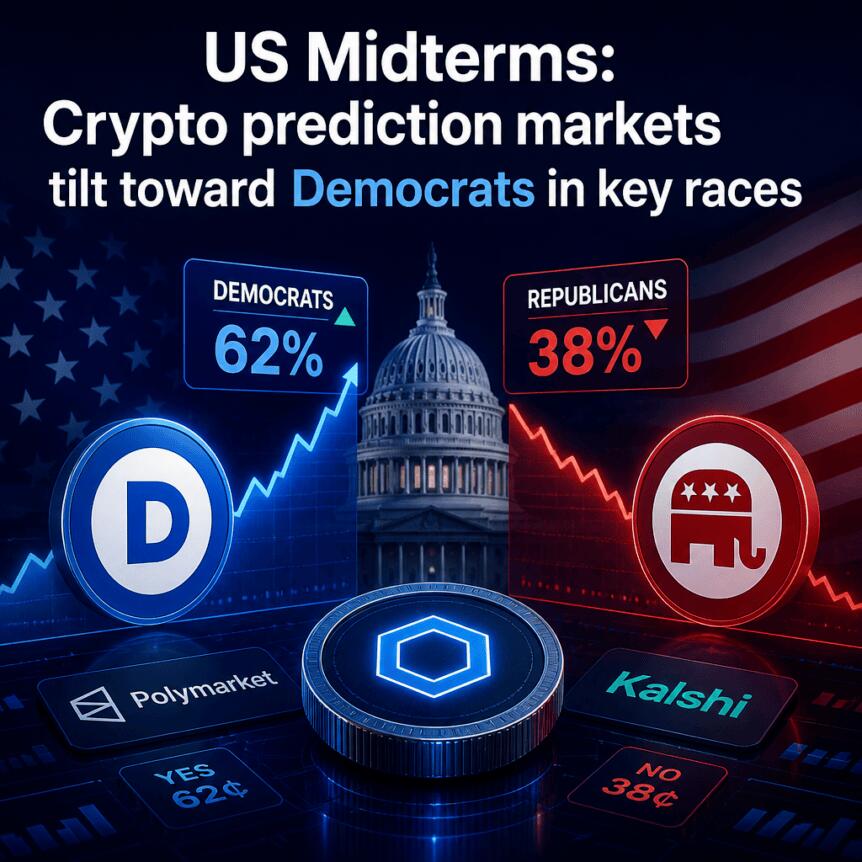
Prediction market activity around the U.S. midterm elections has reached record levels, underscoring how closely crypto-adjacent traders are watching both politics and the policy fallout. According to an analysis by The Washington Post, nearly $1.9 billion in election-related contracts had traded on Kalshi and Polymarket as of Monday, setting a high bar for a midterm cycle.
As election day approaches, both platforms are broadly aligned on the political direction investors are betting on. Markets were pricing a Democratic sweep of Congress at roughly 75% on Kalshi and 75.5% on Polymarket (as of 4:30 p.m. UTC). In the House and Senate races, the odds also favored Democrats—Kalshi showed 93% for taking the House and 75% for winning the Senate, while Polymarket showed 94.5% and 75.5% respectively.
Key takeaways
- $1.9B in election-related prediction-market volume has traded across Kalshi and Polymarket ahead of U.S. midterms, per The Washington Post.
- Both platforms are consistently pricing a Democratic sweep at about 75%, with similar levels for House and Senate control.
- Crypto policy could be reshaped quickly depending on control—especially if Democrats gain the Senate, where committee leadership could influence derivatives and CFTC-related rules.
- Traders are treating several state races as tighter “coin flips,” including Alaska, South Carolina, and Iowa.
- Conditional Polymarket pricing suggests traders see recession risk rising under a Democratic sweep, with an implied 35% chance of a U.S. recession by end-2027 versus 19% if Democrats fall short (as of 4:50 p.m. UTC).
Why election odds matter for crypto traders
Prediction markets are not just a vote-counting exercise; they’re a mechanism for aggregating expectations about policy. In this cycle, the most direct relevance for the crypto industry is the likely pace and direction of regulatory engagement—particularly around market structure, derivatives oversight, and the frameworks that have been discussed for years.
Kalshi and Polymarket’s similar pricing for a Democratic sweep suggests traders have largely converged on the political outcome. Still, their implied probabilities remain far from guarantees. The risk of being “wrong with high confidence” was highlighted earlier in the year when prediction markets failed to anticipate the result of Brazil’s presidential election. CNBC reported that Kalshi CEO Tarek Mansour cautioned that “a 5% probability doesn’t mean it won’t happen”—a reminder that even low-probability outcomes can matter when markets are used to hedge or position.
Ohio: heavy spending, tight expectations
One of the clearest crypto-focused races discussed in this cycle is the Ohio Senate contest. The political involvement of the Fairshake-aligned super PAC network has been significant, with Defend American Jobs reportedly accounting for 54% of the super PAC’s total expenses in the race.
According to the group’s official site, $36.9 million was spent supporting Senator Jon Husted, while $19.7 million was used opposing Sherrod Brown, a long-time crypto critic. The same account noted that Fairshake spent $40 million in 2024 to help unseat Brown. The message from traders this year, however, appears to point in the other direction.
On Kalshi, the market for the Ohio Senate election implied a 72% chance of a Brown win, while Polymarket priced a 72.5% probability for the same outcome (matching a final New York Times/Siena poll that had Brown up 49% to 44%). If traders are right and Brown wins, it could complicate the crypto industry’s legislative path—especially if Democrats regain control of the Senate.
Analysts cited in the original reporting suggested Brown could be positioned to chair the Senate Agriculture Committee, which oversees the Commodity Futures Trading Commission. The outcome for that leadership role remains uncertain, but the possibility alone illustrates why prediction markets are being treated as more than entertainment by market participants tracking regulation.
Maine and state-level momentum for crypto allies
Not every contested seat looks unfavorable for the industry. In Maine, traders leaned toward a Democratic win that could add momentum to pro-crypto influence in Washington.
Kalshi priced Democrat Troy Jackson at a 71% chance of unseating Republican Senator Susan Collins, while Polymarket put the odds at 71.5%. Those probabilities aligned closely with New York Times polling conducted in October, which had Jackson leading by about two percentage points.
The policy signal matters here because Collins was among a small group of Republicans who voted against advancing the CLARITY Act in September, stalling the bill in the Senate. A Jackson victory would therefore represent not only a seat change but also a shift in whether certain crypto policy proposals can move forward.
The original coverage also noted that advocacy group Stand with Crypto rates Jackson as strongly supportive of crypto, which—if reflected in committee work or legislative negotiations—could give the industry another potential ally should Democrats shape the Senate agenda.
Where traders see the most uncertainty
While national direction has become more predictable in the market, traders are making sharper calls in a few states where polling suggested close contests. That split—broad national consensus alongside state-by-state variance—is typical of prediction-market pricing, but it can carry outsized consequences for hedging strategies.
In Alaska, Kalshi placed Democrat Mary Peltola at a 71% chance of defeating Republican Senator Dan Sullivan, even though the final New York Times/Siena poll had Peltola ahead by just two points (48% to 46%). The original reporting also said both candidates have expressed strong support for crypto, citing Stand With Crypto.
In South Carolina, Kalshi gave Republican Darline Graham a 71% chance to defeat Democrat Annie Andrews. That market estimate sits against a New York Times/Siena snapshot that showed the candidates tied at 48%.
Iowa appears closer still. The Kalshi and Polymarket probabilities diverged in timing according to the original reporting, with Polymarket showing Democrat Josh Turek taking the lead at 52% after months in which Hinson had been favored.
For other contests, prediction markets generally tracked the polling. Kalshi, for example, gave Democrat Abdul El-Sayed a 79% chance to defeat Republican Mike Rogers in Michigan, and it gave Democrat James Talarico a 71% chance to beat Republican Ken Paxton in Texas. The underlying New York Times/Siena poll had Talarico leading 50% to 43%.
The reporting also connected the Texas race to broader political spending. A super PAC backed by Gemini co-founders Cameron and Tyler Winklevoss—the Digital Freedom Fund—was said to have spent more than $81,000 supporting Paxton. Even with that context, the key takeaway for traders is that Polymarket and Kalshi are reflecting a consistent edge for Talarico.
What markets price after the vote
Beyond congressional control, traders have started pricing economic scenarios under different political outcomes. Polymarket’s conditional markets suggest that a Democratic sweep could increase perceived recession risk.
As of 4:50 p.m. UTC, Polymarket implied a 35% probability of a U.S. recession by the end of 2027 if Democrats win both chambers, versus 19% if they do not. While this doesn’t translate directly into crypto regulation, it can affect risk appetite, investment timelines, and how quickly markets discount policy uncertainty.
As results become clearer, the biggest question for readers is whether the close-state “coin flips” shift the Senate and House math in ways that force traders to reprice regulatory expectations—especially around committee control and the speed at which major proposals can move. Watching how Kalshi and Polymarket update probabilities through late election results may offer a real-time window into how quickly political risk—economic and regulatory—gets absorbed.
https://www.cryptobreaking.com/us-midterms-crypto-prediction-markets/?utm_source=blogger%20&utm_medium=social_auto&utm_campaign=US%20Midterms:%20Crypto%20prediction%20markets%20tilt%20toward%20Democrats%20in%20key%20races%20
Comments
Post a Comment