
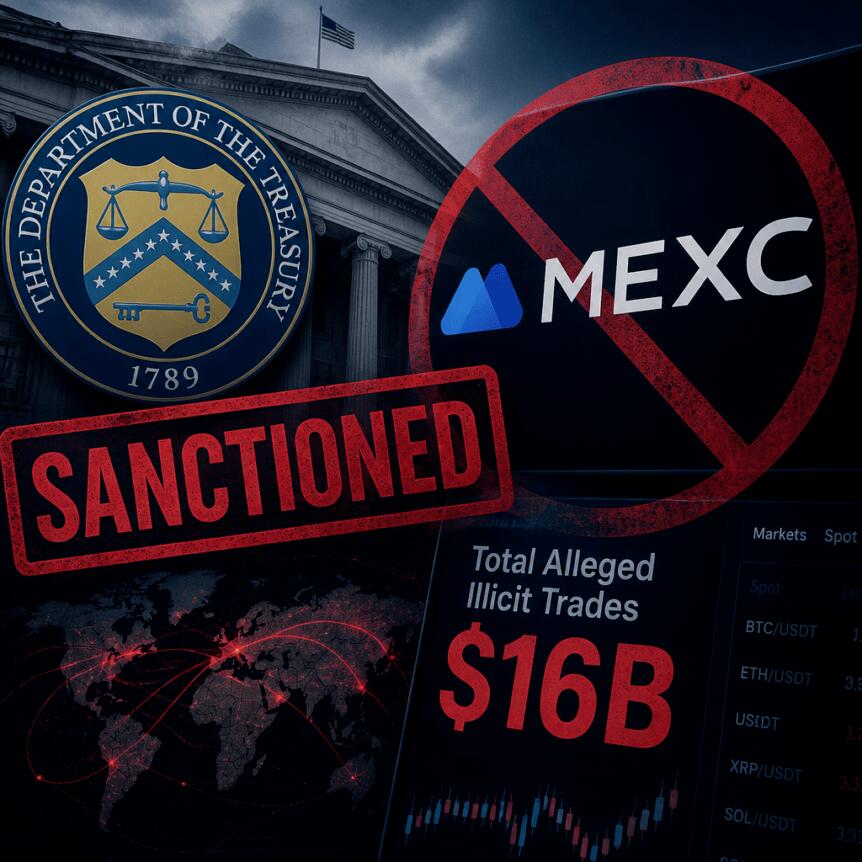
The U.S. Department of the Treasury has issued an order cutting cryptocurrency exchange MEXC Global off from the country’s financial system, alleging the platform facilitated large volumes of transactions tied to sanctions evasion, cybercrime, and other illicit activity.
The Treasury’s Financial Crimes Enforcement Network (FinCEN) said MEXC processed transactions connected to sanctioned groups in Iran, Russia, and North Korea between May 2021 and May 2026. The agency cited figures including approximately $1.5 billion tied to Russian sanctions evasion, according to the government release.
Key takeaways
- FinCEN’s order bars U.S. financial institutions from processing certain transfers involving MEXC, effectively limiting the exchange’s access to the U.S. financial rails.
- The Treasury alleges MEXC handled transactions linked to sanctioned groups in Iran, Russia, and North Korea over a five-year period (May 2021 to May 2026).
- The order will take effect 30 days after publication in the Federal Register, leaving a short window before the compliance impact begins.
- The action is tied to Operation Economic Outcast, a Treasury initiative aimed at reducing support for Iran-related sanctions circumvention.
- DefiLlama data referenced in coverage shows MEXC held about $4.48 billion in total assets as of Friday.
FinCEN order targets MEXC’s alleged illicit flows
FinCEN’s enforcement action comes in the form of an order—issued by the Treasury—that is designed to sever a sanctioned exchange’s ability to interact with U.S. financial institutions. In practical terms, the order restricts U.S. banks and other financial entities from processing money transfers involving MEXC.
The Treasury’s stated rationale is focused on the exchange’s role in transactions the agency associates with illicit activity. FinCEN alleged that, during the period from May 2021 to May 2026, MEXC handled transactions involving sanctioned groups across multiple countries, including Iran, Russia, and North Korea.
Among the specific allegations highlighted in the press release is the claim that around $1.5 billion in transactions were linked to Russian sanctions evasion. The Treasury also pointed to broader links it characterized as supporting cybercrime and other illicit activity, although the details are presented in the context of the agency’s overall determination rather than as a single isolated case.
U.S. financial access cut-off begins after Federal Register publication
While the order was announced Friday, its immediate effect is not instant for U.S. institutions. The Treasury stated the measure will take effect 30 days after it is published in the Federal Register.
That timing matters for market participants because it creates a compliance transition period: banks and payment providers can align internal processes, and exchanges or counterparties may adjust operational workflows to avoid processing restricted transfers involving MEXC once the ban becomes active.
For investors and traders who use MEXC, the bigger implication is that access to U.S. financial infrastructure—often a key bridge between fiat rails and crypto trading—can become more constrained as the order’s effective date approaches.
Operation Economic Outcast expands U.S. pressure on sanctions circumvention
The Treasury framed the move as part of Operation Economic Outcast, a campaign it launched in August focused on entities that assist Iran in evading U.S. sanctions. Although the allegations referenced in the order span Iran, Russia, and North Korea, the operation’s stated objective underscores the U.S. government’s broader strategy: reduce the channels through which sanctioned actors can maintain economic activity.
In remarks accompanying the action, U.S. Treasury Secretary Scott Bessent said financial institutions cannot “have it both ways,” asserting that supporting sanctioned regimes should not coexist with access to the U.S. financial system. He added that the Treasury intends to continue severing what it described as the Iranian regime’s economic lifelines and counter efforts to circumvent U.S. sanctions using digital assets.
For the sector, the key question is whether enforcement momentum will concentrate on exchanges with meaningful U.S. touchpoints or on platforms perceived as central to cross-border illicit flows. This order signals that the Treasury views major centralized crypto venues as potential choke points in the sanctions-evasion ecosystem.
What the reported scale suggests for traders and the exchange
Coverage accompanying the order noted that, according to DefiLlama, MEXC held about $4.48 billion in total assets as of Friday. While total assets do not directly measure the amount of U.S.-related activity, they do provide context for how significant the platform is in the broader market.
Cointelegraph reported that it contacted MEXC for comment but did not receive a response by publication. That absence leaves open how the exchange intends to handle the compliance changes that follow Federal Register publication, and whether it will contest the Treasury’s findings through any formal process.
For users, the immediate practical effect is likely to show up in banking and payment workflows—especially for services that depend on U.S. counterparties. Traders should also watch for potential knock-on effects, such as changes in withdrawal processing, counterpart access, or liquidity distribution as market participants adjust to restricted rails.
More broadly, the enforcement action illustrates how regulatory pressure can translate into operational constraints for global crypto platforms. Even when a platform is not U.S.-based, the Treasury’s approach targets the gatekeeping role of U.S. financial institutions—creating leverage that can ripple outward through banking partners and payment processors.
Going forward, market participants should monitor the Federal Register publication date and the 30-day timeline to see when restrictions formally begin. They should also look for any follow-up from MEXC regarding compliance plans or challenges to FinCEN’s claims, as well as for indications of how counterparties will adjust their systems once the order becomes enforceable.
https://www.cryptobreaking.com/us-treasury-sanctions-mexc-citing-2/?utm_source=blogger%20&utm_medium=social_auto&utm_campaign=US%20Treasury%20sanctions%20MEXC,%20citing%20$16B%20in%20alleged%20illicit%20trades%20
Comments
Post a Comment