
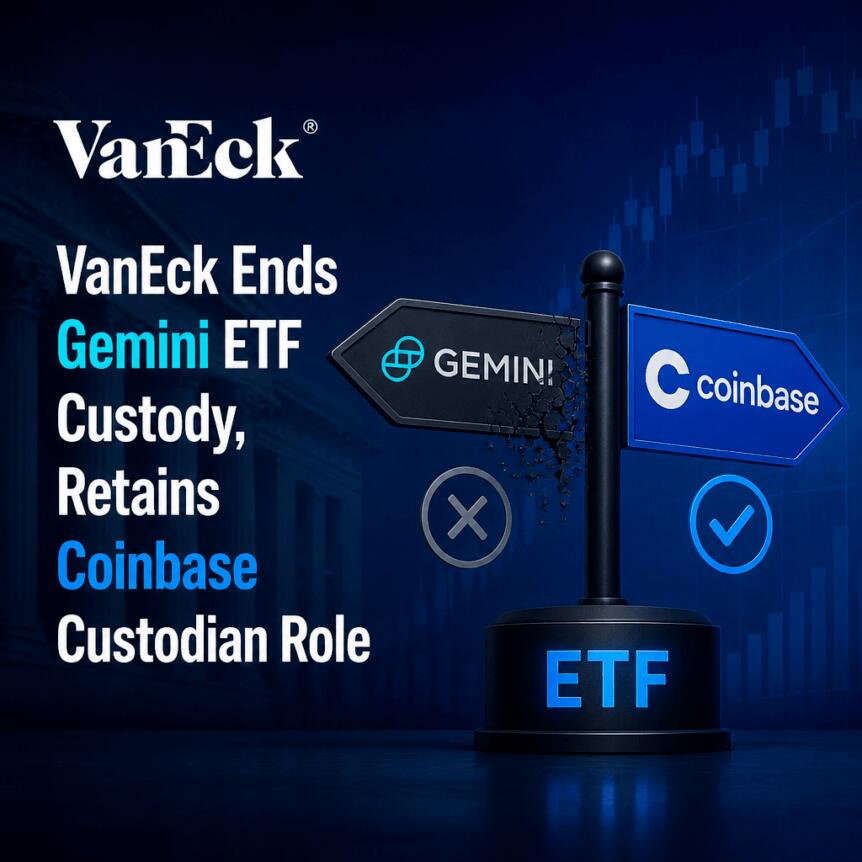
VanEck is winding down its custody and clearing arrangements with Gemini across three US spot crypto exchange-traded funds, according to filings made with the US Securities and Exchange Commission (SEC). The ETFs in question are VanEck’s Bitcoin (HODL), Ether (ETH) and Solana (VSOL) products, with the terminations set to end “on or about” Feb. 16, 2027.
In the same filings, VanEck indicates that Coinbase Custody will continue providing custody services for these funds, even as Gemini’s role is scheduled to end. The SEC paperwork does not spell out why the relationships are being terminated, but the change adds to scrutiny around how US spot crypto ETF infrastructure is managed among custodians.
Key takeaways
- VanEck notified the SEC that it will terminate custody and clearing agreements with Gemini for its Bitcoin, Ether and Solana ETFs.
- The custody/clearing arrangements are set to end “on or about” Feb. 16, 2027, per the SEC filings.
- Coinbase Custody is expected to remain the custodian for the funds during and after Gemini’s exit.
- VanEck’s Solana ETF filings also reference a Gemini staking services agreement, raising questions about how staking operations will be handled after the transition.
Gemini’s custody and clearing role ends for VanEck’s spot ETFs
Separate SEC filings made available Thursday show VanEck has directed the termination of its custody and clearing agreements with Gemini for three exchange-traded funds: its spot Bitcoin ETF, spot Ether ETF, and spot Solana ETF. The notification was sent to Gemini on Monday, with the agreements ending around mid-February 2027.
While the filings clearly outline the end dates for Gemini’s agreements, they do not disclose the rationale behind the change. That omission leaves investors to infer that the decision likely relates to operational preferences, contractual terms, or a broader restructuring of how VanEck manages its ETF back-office providers—especially since the funds’ custody continuity is handled by another firm.
For readers watching the US spot ETF market, the key operational detail is that Coinbase Custody is already involved: VanEck’s filings state that Coinbase Custody, which already serves these funds, will continue providing custody services. In other words, the update does not appear to shift custody away from Coinbase; rather, it reduces Gemini’s responsibilities for these particular VanEck products.
Coinbase Custody remains in place as Gemini steps out
The Gemini-to-Coinbase overlap matters because custody has become a core pillar of the US spot crypto ETF ecosystem. According to the filings, VanEck’s arrangements with Gemini for custody and clearing are being terminated even though Coinbase Custody continues to provide custody. This structure suggests VanEck will maintain a familiar custody provider while adjusting other aspects of the fund’s infrastructure where Gemini was previously involved.
That distinction is important: “custody” and “clearing” can involve different workflows and counterparties in ETF operations. By ending both custody and clearing agreements, VanEck is effectively removing Gemini from multiple points in the process for the funds covered by the filings. What changes operationally for the ETF—beyond the contractual relationships themselves—may depend on how the remaining service providers re-route tasks previously handled by Gemini.
For market participants, the most practical question is what this means for service continuity and timelines. With the agreements scheduled to end “on or about” Feb. 16, 2027, there is a defined transition window. ETF investors typically care less about the legal relationship and more about whether the change affects settlement processes, custody operations, and fund administration during that period.
Solana ETF filing points to a Gemini staking services agreement
The termination also reaches beyond straightforward custody. VanEck’s Solana ETF filing (VSOL) references a Gemini staking services agreement alongside the custody and clearing terms. Because staking can generate additional rewards for proof-of-stake networks, staking arrangements can influence an ETF’s overall economics and how it manages returns.
Staking generally works by having tokenholders’ assets support network security—earning rewards in return. For ETFs that choose to stake their holdings, staking services may be part of the operational setup that converts the fund’s Solana exposure into potential staking yield.
VanEck’s filings therefore raise a clear watch item for readers: once Gemini’s staking services agreement is terminated as part of the broader relationship unwind, how will the ETF handle staking? The filings indicate Gemini is tied to staking services, but they do not, in the provided material, specify the post-transition staking operator or the exact new mechanism for generating any staking-related returns.
Cointelegraph attempted to contact both VanEck and Gemini for comment on the reasoning for the terminations and potential impacts on Solana ETF staking operations, but did not receive a response by the time of publication.
Gemini’s early role in US spot Bitcoin ETFs
Gemini’s departure from these VanEck funds also underlines its long association with early spot Bitcoin ETF development in the United States. Gemini founders Cameron and Tyler Winklevoss were among the early proponents of a spot Bitcoin ETF, including filing to launch the Winklevoss Bitcoin Trust in July 2013. US regulators ultimately approved spot Bitcoin ETFs in January 2024—more than a decade after the brothers’ initial filing.
Gemini also served as the original Bitcoin custodian for VanEck’s spot Bitcoin ETF when it launched in January 2024. Later, VanEck added Coinbase Custody in June 2024, according to SEC documentation. This sequencing suggests Gemini’s role may have diminished over time as VanEck layered in additional infrastructure providers.
As of the Thursday references in the source material, VanEck’s Bitcoin ETF (HODL) is notably smaller than the biggest US spot Bitcoin funds, with assets under management cited at about $880 million. By comparison, Wallet Pilot data in the provided text cites about $47.6 billion for BlackRock’s iShares Bitcoin Trust (IBIT) and about $10.6 billion for Fidelity’s Wise Origin Bitcoin Fund (FBTC).
Separately, Gemini continues to provide custody services for some crypto ETF activity outside the VanEck lineup. The source text notes Gemini custody involvement for at least one smaller US ETF—identified in a September 2026 regulatory filing as the 7RCC Spot Bitcoin and Carbon Credit Futures ETF (BTCK). The referenced filing identifies Gemini and BitGo as Bitcoin custodians.
What to monitor as the 2027 transition approaches
With Gemini’s custody, clearing, and staking-related agreements for VanEck’s spot ETFs set to end around Feb. 16, 2027, investors should watch for how VanEck documents the final operational handoff for Solana staking and whether similar infrastructure changes appear across other ETF sponsors. The SEC filings establish the “when,” but readers will want clarity on the “how” before the transition window narrows.
https://www.cryptobreaking.com/vaneck-ends-gemini-etf-custody-2/?utm_source=blogger%20&utm_medium=social_auto&utm_campaign=VanEck%20Ends%20Gemini%20ETF%20Custody,%20Retains%20Coinbase%20Custodian%20Role%20
Comments
Post a Comment