
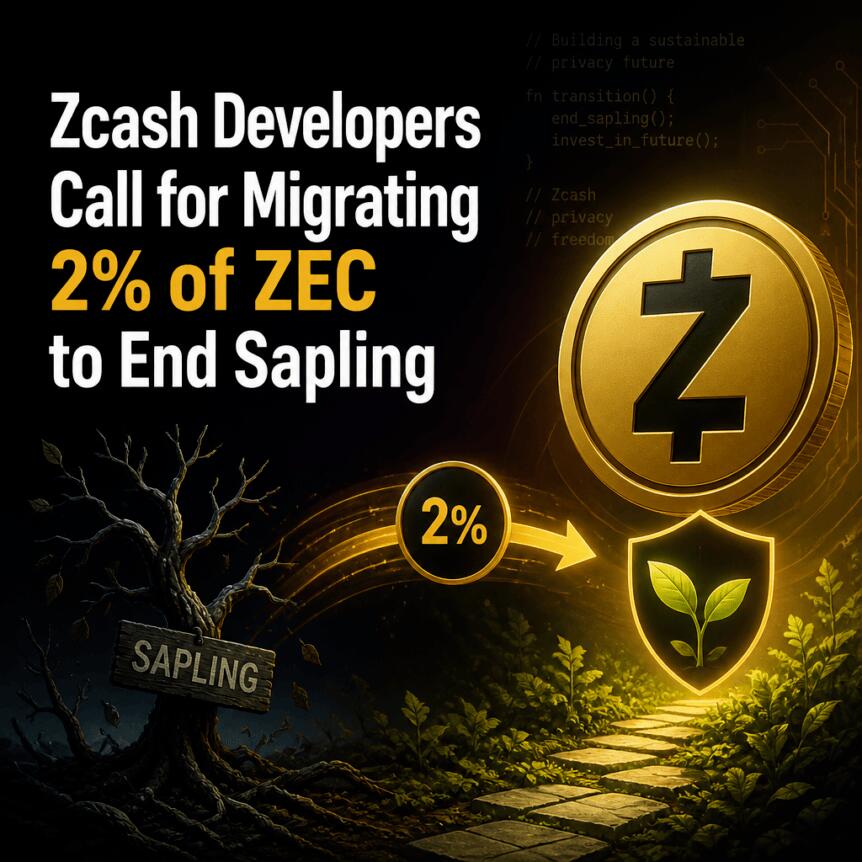
Zcash’s development team has urged the network community to accelerate the migration away from Sapling, one of the blockchain’s older shielded transaction pools. In a message shared with community members on Wednesday, Zakura—led by co-founder Sean Bowe and developer Dev Ojha—said Sapling currently represents nearly 2% of the total Zcash token supply and includes roughly 400,000 Zcash (ZEC) held within the pool, valued at about $302 million.
Instead of an abrupt shutdown, the team’s proposal focuses on stopping new deposits while keeping Sapling withdrawals available. That approach would give existing holders a clear path to move their funds into Zcash’s newer shielded pool, Ironwood.
Key takeaways
- Zakura wants faster retirement of Sapling, citing its share of the supply and the security implications of older cryptographic constructions.
- The recommended migration plan is “deposit stop, withdrawal open,” so holders can move funds without being stranded.
- Ironwood uses a different proof system designed to avoid the pairing-based cryptography Zakura says may become vulnerable over time.
- A withdrawal-only shift was discussed for April 2026, building toward longer-term Sapling deprecation.
- Zcash previously acted on shielded-pool risk: Orchard transactions were briefly paused on June 3 after a vulnerability, then restored via an emergency upgrade.
Why Sapling is on the team’s “accelerate” list
In its community update, Zakura argued that Sapling’s cryptographic foundations could become a liability as mathematical and computational capabilities advance. The team highlighted that AI-accelerated progress in mathematical techniques could eventually undermine the pairing-based cryptography underlying Sapling.
If that risk materializes, Zakura warned attackers might be able to forge transaction proofs. In the worst case, that could allow fraudulent transactions, including the potential to create counterfeit ZEC. While such scenarios remain theoretical, the team’s point is practical: the longer Sapling remains active, the more exposure the ecosystem has to future cryptanalytic breakthroughs.
Ironwood, by contrast, uses a different proof mechanism that does not rely on the same kind of pairings that Zakura singled out. That makes Ironwood the migration target for users seeking to reduce reliance on the older cryptographic approach.
A migration path designed to reduce user friction
Zakura’s message to the community is centered on a staged change rather than an immediate deactivation. The proposal is to use a network upgrade that prevents new deposits into Sapling, while leaving withdrawals enabled so existing users can migrate to Ironwood.
For Zcash holders, the distinction matters. A deposit stop addresses the long-term security exposure, but keeping withdrawals open recognizes that balances already placed in Sapling are part of the current user experience. The team’s framing suggests that holders should not have to wait indefinitely for a future migration window; instead, they should move proactively.
The team also pointed to an earlier development discussion about a further restriction. Dev Ojha previously proposed making Sapling withdrawal-only as early as April 2026, according to a kickoff thread on the Zcash community forum. Moving from deposit-and-withdraw behavior toward withdrawal-only is effectively a multi-step “sunset” plan—reducing Sapling’s future growth while allowing time for users to shift positions.
Shielded pool risks have already triggered network response
The push to retire Sapling arrives in a context where Zcash developers have previously needed to intervene in shielded pool functionality. On June 3, Zcash developers temporarily suspended Orchard transactions after discovering a vulnerability in the shielded pool. Functionality was restored later that day through an emergency upgrade.
The Zcash Foundation later stated there was no evidence that the vulnerability had been exploited. Even so, the episode underscores that shielded pools remain an area requiring continuous vigilance, rapid engineering response, and careful upgrades—especially because privacy systems demand strong correctness guarantees.
While Sapling and Orchard are different shielded pools, the broader implication is that Zcash’s privacy layer will continue to require periodic risk management. For investors and users, the practical takeaway is that governance and engineering decisions around pool transitions are not purely academic; they can affect how quickly developers act when new concerns emerge.
What readers should watch next
The immediate question is how quickly users and integrators respond to Zakura’s call to begin migrating from Sapling to Ironwood. The next milestone to monitor is whether the network implements an upgrade that stops new Sapling deposits, as the team recommends, and how that interacts with the longer-term plan to shift Sapling toward withdrawal-only behavior.
Beyond that, readers should also watch for further details on the cryptographic risk assessment and how the team communicates uncertainty. Even if Sapling retirement is driven by plausible future threats rather than confirmed breakage, the timeline of migration upgrades will determine how quickly Zcash can reduce its exposure to older constructions.
https://www.cryptobreaking.com/zcash-developers-call-for-migrating/?utm_source=blogger%20&utm_medium=social_auto&utm_campaign=Zcash%20Developers%20Call%20for%20Migrating%202%%20of%20ZEC%20to%20End%20Sapling%20
Comments
Post a Comment