
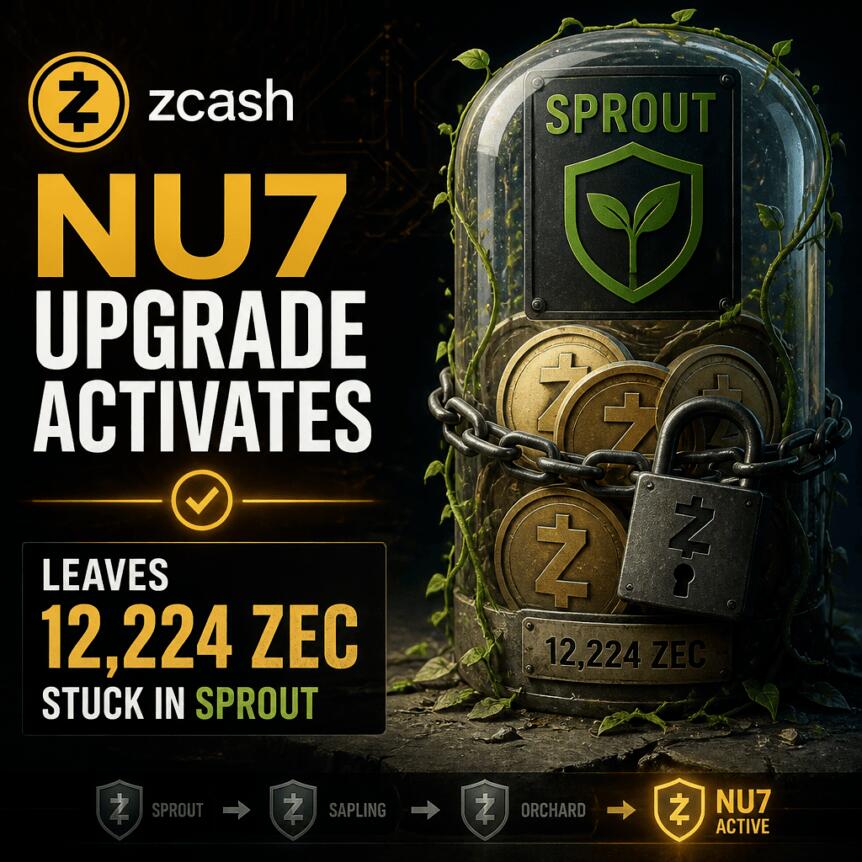
Zcash activated its NU7 network upgrade on Friday, triggering a technical change that affects how older shielded funds can be spent. At the time of activation, Zcash’s legacy Sprout shielded pool became effectively unreachable for holders, with ZEC locked there estimated at roughly $15 million.
The NU7 rollout took effect at block 3,543,405 at 02:34 UTC, according to blockchain tracking data from ZecStats. ZecStats lists the Sprout pool balance at about 12,224 ZEC, which now cannot be spent under the new rules.
Key takeaways
- NU7 activated at block 3,543,405 (02:34 UTC), with Zcash’s legacy Sprout funds becoming non-spendable post-upgrade.
- Based on ZecStats, the Sprout pool holds about 12,224 ZEC at activation, estimated at roughly $15 million.
- ZIP 2003 changes transaction acceptance so that NU7 rejects “version 4” transactions, the format tied to spending Sprout balances.
- NU7 introduces a Network Sustainability Mechanism that removes 60% of transaction fees from circulation for eventual reissuance via mining rewards starting around February 2031.
- Zcash keeps its 21 million ZEC supply cap and halving schedule, while adding operational limits aimed at reducing wallet synchronization strain.
NU7 activation and the Sprout spending lock
The practical headline for NU7 is the change in spendability for funds inside Zcash’s older Sprout shielded pool. The upgrade follows the Zcash Improvement Proposal (ZIP) 2003, which adjusts protocol rules so that the network will no longer accept specific transaction formats tied to Sprout spending.
According to the upgrade details described under ZIP 2003, NU7 rejects version 4 transactions. Those version 4 transactions are the mechanism that supports spending Sprout funds. As a result, holders cannot transfer or redeem the Sprout-balance UTXOs under the new rules.
Importantly, NU7 does not burn the coins. The specification treats the funds as still present on-chain, but effectively non-spendable under the new transaction validation logic. In other words, the upgrade changes accessibility rather than deleting supply from circulation.
What changes for block production timing
Beyond spendability, NU7 also updates Zcash’s block timing target. As outlined in earlier reporting from Cointelegraph—referencing the NU7 mainnet activation—the upgrade reduces Zcash’s target time between blocks from 75 seconds to 25 seconds.
However, the protocol’s real-world block intervals will not immediately snap to the new target. Network behavior will “adjust toward the new target” as mining difficulty shifts in response to the changed target. This matters for miners and anyone monitoring network throughput: the jump from a longer to a shorter target can alter how quickly blocks are expected to be produced, but difficulty retuning smooths that transition.
Can Sprout access return later?
While NU7 makes Sprout funds non-spendable under the current rule set, the specification explicitly leaves open the possibility of future recovery. A later network upgrade could, in theory, re-enable spending—either by restoring support for the transaction format that allows Sprout redemption or by introducing a different mechanism to retrieve those funds.
At the same time, the document includes a caution: the ability to spend Sprout funds may never be re-enabled. That caveat is central for users deciding how to think about legacy shielded holdings going forward—there is a path for change, but no guarantee.
For investors and users, the uncertainty is meaningful even if the headline number of affected ZEC is relatively small compared with overall circulation. The pool’s balance at activation (as tracked by ZecStats) becomes a reference point to watch in the event of any subsequent proposals aiming to restore or migrate legacy shielded balances.
Network Sustainability Mechanism and long-term fee dynamics
NU7 also introduces the Network Sustainability Mechanism, a protocol-level change intended to affect Zcash’s long-run economics. Under the mechanism, 60% of transaction fees are removed from circulation and held for eventual reissuance through future mining rewards.
The timing is specified as beginning around February 2031. That means the immediate effect is not a reduction in fees paid, but rather a change in how a large portion of those fees contributes to monetary flow over time. Instead of that value simply sitting in the normal path toward miner revenues, it is set aside for later reappearance via mining rewards.
Crucially, NU7 preserves Zcash’s established macroeconomic design: it maintains the 21 million ZEC supply cap and the halving schedule. The upgrade is therefore positioned as an economic “routing” change rather than an alteration to the supply ceiling or issuance schedule.
Operational limits for shielded activity
Another element of NU7 focuses on reducing operational burden on wallets. The upgrade preserves supply and issuance rules, but introduces limits on shielded activity designed to cut down on wallet synchronization demands.
In practice, that addresses a pain point for participants using shielded pools: syncing and maintaining wallet state can be resource-intensive when network activity is high or when data structures require heavier processing. By limiting certain types or scopes of shielded behavior, NU7 aims to make wallet operations more manageable without changing the broader availability of Zcash itself.
The trade-off is that participants who rely on the legacy Sprout pool now face a hard protocol limitation on spending, while newer shielded approaches continue to function under the upgraded validation rules.
With NU7 live, the main things to watch are whether any future network upgrades explicitly attempt to restore Sprout access and how mining difficulty and network behavior settle after the block-time target change. ZecStats’ tracking of NU7-related changes also provides a practical window into how much legacy data remains affected and whether subsequent proposals move from theoretical recovery to implementation.
https://www.cryptobreaking.com/zcash-nu7-upgrade-activates-leaves/?utm_source=blogger%20&utm_medium=social_auto&utm_campaign=Zcash%20NU7%20Upgrade%20Activates,%20Leaves%2012,224%20ZEC%20Stuck%20in%20Sprout%20
Comments
Post a Comment