Coinbase Warns New Stablecoin Rules Could Benefit China


US Stablecoin Regulation and Global Competition: Industry Leaders Warn of Potential Setbacks


A senior executive at Coinbase has issued a stark warning regarding upcoming changes to the US stablecoin regulatory framework, suggesting that these modifications could diminish America's leadership in the international digital payments arena. As China advances its central bank digital currency (CBDC) initiatives, tensions are mounting over the competitive landscape of digital finance.


Faryar Shirzad, Coinbase’s chief policy officer, expressed concern via X about the implications of the GENIUS Act, which governs stablecoin issuance in the US. Specifically, he highlighted that restrictions preventing stablecoin platforms from offering rewards—linked to the law’s provisions—could hamper the global competitiveness of US dollar-pegged digital assets. Shirzad pointed out that China’s recent announcement indicating the introduction of interest payments on digital yuan wallets from January 2026 signals a swift move to extend the functionality of its CBDC beyond mere digital cash, integrating it deeply into banks' asset management and cross-border payment systems.
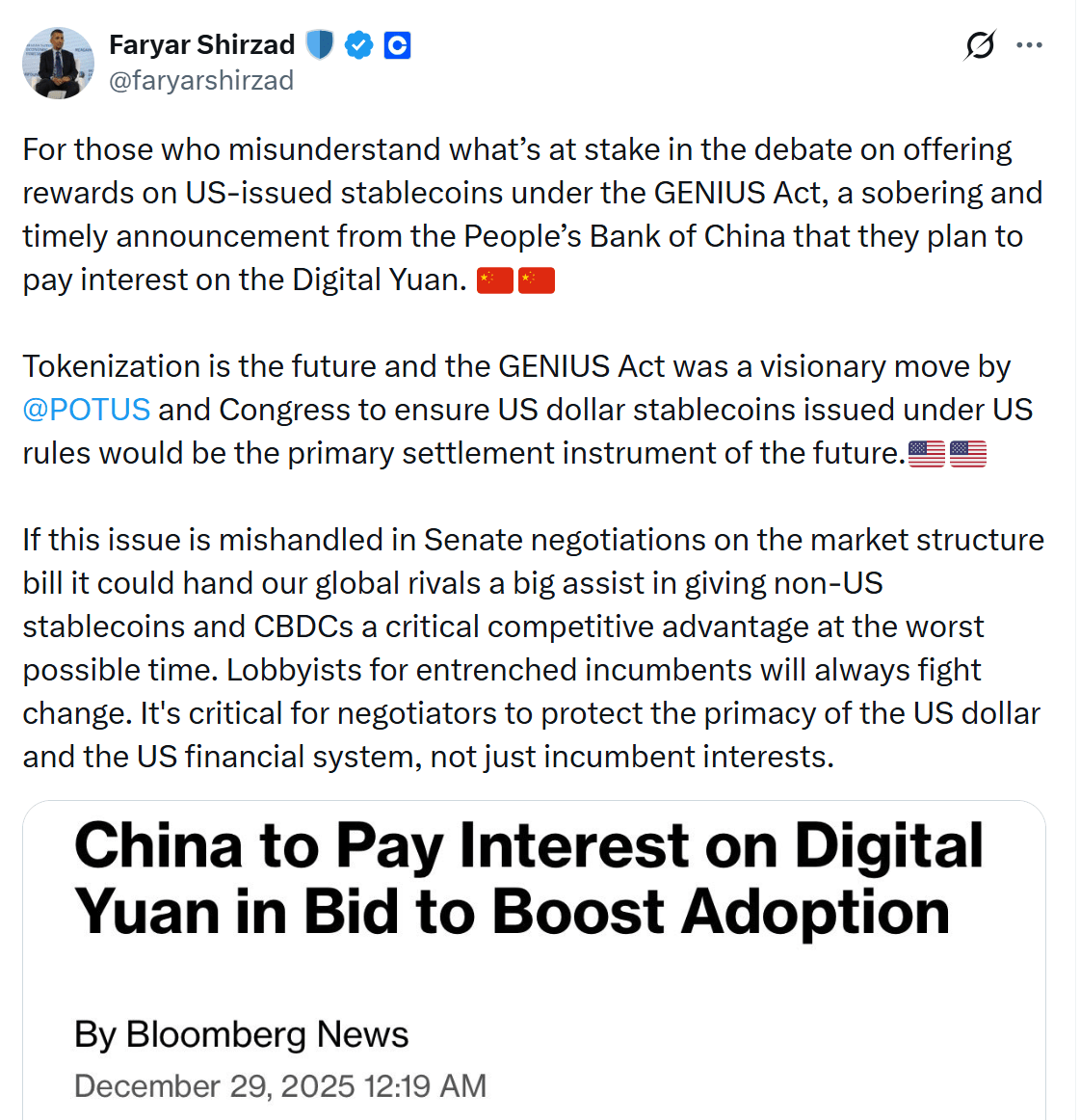


Faryar Shirzad warns against modifying the GENIUS Act. Source: Faryar Shirzad


Amplifying Competition Concerns: The Stablecoin Rewards Debate


The GENIUS Act, passed in June, sets reserve and compliance standards for stablecoins but explicitly prohibits issuers from paying direct interest. However, it permits third-party reward programs that incentivize stablecoin use. Industry insiders warn that these restrictions could inadvertently bolster foreign competitors by making non-US stablecoins and CBDCs more attractive in the market.


Commentators like Max Avery, a crypto policy analyst, have voiced fears that lobbying efforts aim to reopen the law, which could fortify rival nations’ strategic position in digital currency adoption. Avery noted that while US banks currently earn approximately 4% on reserves held at the Federal Reserve, consumers see minimal returns on savings accounts. Stablecoin platforms, offering yield-sharing opportunities, threaten to disrupt that traditional banking model.


Coinbase’s CEO Stakes a “Red Line” Against Revisions


Coinbase CEO Brian Armstrong emphasized his opposition to efforts aimed at reopening the GENIUS Act, describing such moves as a “red line.” He accused banks of lobbying aggressively to limit stablecoin rewards, ostensibly to protect their deposit bases, and warned that the industry must resist these efforts. Armstrong also conveyed skepticism about the banks’ long-term intentions, suggesting they will eventually seek to offer interest on stablecoins once regulatory conditions are more favorable.


Despite these warnings, industry observers see the ongoing lobbying as an unorthodox approach, risking to undermine US leadership in the evolving digital payments landscape amidst rising global competition.


https://www.cryptobreaking.com/coinbase-warns-new-stablecoin-rules/?utm_source=blogger%20&utm_medium=social_auto&utm_campaign=Coinbase%20Warns%20New%20Stablecoin%20Rules%20Could%20Benefit%20China%20

Comments

Popular posts from this blog

Coinbase's x402 launches AI agents app store for payments

Coinbase-backed x402 has unveiled Agentic.market, a dedicated marketplace aimed at increasing the usefulness of AI agents by aggregating thousands of apps and services that agents can access without any API keys. The rollout positions the platform as a central hub for agents to discover, evaluate, and deploy capabilities across a standardized payments layer. Coinbase product lead Nick Prince described Agentic.market in a video posted on X as a storefront for discovering, comparing, and using x402 services. The marketplace is designed to give both humans and their AI agents access to a wide range of tools—from data feeds to consumer apps—without the friction of managing API credentials. A storefront for discovering, comparing, and using x402 services. Thousands of services. Zero API keys. Powered by x402. Prince added that the market offers a web interface for humans to browse and assess services, alongside a programming layer that lets AI agents autonomously search, filter, and integra...

Scaramucci Family Invests $100M in Trump-Backed Bitcoin Mining Firm

The recent investment in American Bitcoin highlights the growing interest and participation of prominent figures and families in the cryptocurrency mining sector, particularly in the United States. With over $100 million from the Scaramucci family’s Solari Capital and backing from notable entrepreneurs and investors, American Bitcoin is solidifying its position as a significant player in the evolving blockchain and crypto markets. This move underscores the increasing institutional and individual involvement in Bitcoin and related assets, shaping the future of the crypto industry amidst regulatory and market dynamics. The Scaramucci family’s private investment firm, Solari Capital, has committed over $100 million to American Bitcoin, a major U.S.-based mining company. American Bitcoin raised $220 million in a funding round before going public via reverse merger, with notable backers including Tony Robbins, Charles Hoskinson, Grant Cardone, and Peter Diamandis. The company ...

AML Fines Surpass SEC Cases, Elevating Crypto Regulatory Risk

Anti-money-laundering enforcement has overtaken securities violations as the principal regulatory threat facing crypto firms, according to CertiK’s State of Digital Asset Regulations report. The U.S. Department of Justice and the Financial Crimes Enforcement Network together imposed more than $1 billion in AML-related fines during the first half of 2025. The development signals a sharp regulatory pivot away from the Securities and Exchange Commission-led enforcement cycle that once dominated crypto compliance discourse. CertiK notes that SEC crypto-specific penalties collapsed in value, falling from $4.9 billion in 2024 to about $142 million in 2025, a trend the firm attributes to shifts in policy priorities and jurisdictional focus. According to CertiK’s findings, transaction-monitoring and licensing lapses are now generating penalties that rival or exceed many prior securities cases. High-profile settlements illustrate the trend: the Department of Justice’s February 2025 resolution w...