XRP ETFs Continue 29-Day Inflow Streak Despite December Market Selloff


Stable XRP ETF Inflows Persist Amid Market Turbulence


Despite a volatile December for the broader crypto market, spot XRP exchange-traded funds (ETFs) in the United States continued to demonstrate resilience by maintaining inflows over a sustained 29-day period. As of the end of the month, these ETFs accumulated a total net inflow of $8.44 million on Monday alone, bringing their overall inflows to $1.15 billion since launch, with total assets reaching approximately $1.24 billion, even as XRP prices and the larger crypto sector faced selling pressures.


Vincent Liu, Chief Investment Officer at Kronos Research, noted that investments in XRP are largely driven by increasing regulatory clarity and a shift toward less crowded trading strategies compared to Bitcoin or Ethereum. He emphasized that XRP's unique use case in cross-border settlement solutions "offers differentiated exposure that continues to attract longer-term investors," supporting the ongoing capital influx despite broader market challenges.


While the recent inflows have slowed from earlier surges that saw daily additions spike from $30 million to over $40 million, XRP ETFs have nonetheless experienced consistent growth throughout December. In total, the funds attracted $478 million during the month, signaling continued investor interest in the token's potential for leaner, strategic positioning.
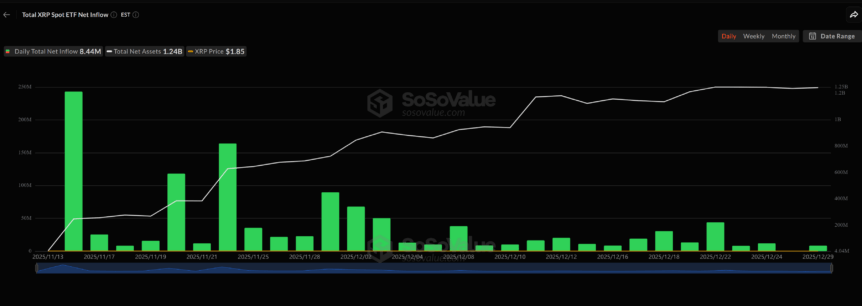


XRP ETFs have seen continued inflows since launch. Source: SoSoValue


December’s Broader ETF Landscape: Bitcoin and Ethereum Under Pressure


In contrast to XRP's steady inflows, Bitcoin and Ether ETFs experienced significant net outflows during December. Both saw over $1.7 billion in combined withdrawals, with Bitcoin alone losing more than $1.1 billion over the month. The largest single-day redemption occurred on December 15, when investors withdrew $357.7 million. Ethereum-focused ETFs exhibited a similar trend, losing approximately $612 million, with notable withdrawals on December 15 and 16.


Vincent Liu explained that Bitcoin is expected to trade within a broad, range-bound bullish pattern, supported by institutional positioning and macroeconomic factors. Conversely, he suggested that Ether might outperform Bitcoin due to increased network adoption and real-world utility, potentially driving stronger fundamental growth.


Institutional Demand Shows Signs of Cooling


Recent data from Glassnode indicates that the 30-day moving average of net inflows into U.S. Bitcoin and Ether ETFs has remained negative since early November. This trend suggests subdued institutional participation and a general contraction in market liquidity. Despite this, Liu pointed out that Bitcoin ETF outflows over Christmas were likely linked to holiday repositioning and thinner market liquidity, rather than a fundamental decline in demand. He expects institutional activity to normalize as markets reopen in early January, potentially restoring liquidity and confidence.


https://www.cryptobreaking.com/xrp-etfs-continue-29-day/?utm_source=blogger%20&utm_medium=social_auto&utm_campaign=XRP%20ETFs%20Continue%2029-Day%20Inflow%20Streak%20Despite%20December%20Market%20Selloff%20

Comments

Popular posts from this blog

Coinbase's x402 launches AI agents app store for payments

Coinbase-backed x402 has unveiled Agentic.market, a dedicated marketplace aimed at increasing the usefulness of AI agents by aggregating thousands of apps and services that agents can access without any API keys. The rollout positions the platform as a central hub for agents to discover, evaluate, and deploy capabilities across a standardized payments layer. Coinbase product lead Nick Prince described Agentic.market in a video posted on X as a storefront for discovering, comparing, and using x402 services. The marketplace is designed to give both humans and their AI agents access to a wide range of tools—from data feeds to consumer apps—without the friction of managing API credentials. A storefront for discovering, comparing, and using x402 services. Thousands of services. Zero API keys. Powered by x402. Prince added that the market offers a web interface for humans to browse and assess services, alongside a programming layer that lets AI agents autonomously search, filter, and integra...

Scaramucci Family Invests $100M in Trump-Backed Bitcoin Mining Firm

The recent investment in American Bitcoin highlights the growing interest and participation of prominent figures and families in the cryptocurrency mining sector, particularly in the United States. With over $100 million from the Scaramucci family’s Solari Capital and backing from notable entrepreneurs and investors, American Bitcoin is solidifying its position as a significant player in the evolving blockchain and crypto markets. This move underscores the increasing institutional and individual involvement in Bitcoin and related assets, shaping the future of the crypto industry amidst regulatory and market dynamics. The Scaramucci family’s private investment firm, Solari Capital, has committed over $100 million to American Bitcoin, a major U.S.-based mining company. American Bitcoin raised $220 million in a funding round before going public via reverse merger, with notable backers including Tony Robbins, Charles Hoskinson, Grant Cardone, and Peter Diamandis. The company ...

AML Fines Surpass SEC Cases, Elevating Crypto Regulatory Risk

Anti-money-laundering enforcement has overtaken securities violations as the principal regulatory threat facing crypto firms, according to CertiK’s State of Digital Asset Regulations report. The U.S. Department of Justice and the Financial Crimes Enforcement Network together imposed more than $1 billion in AML-related fines during the first half of 2025. The development signals a sharp regulatory pivot away from the Securities and Exchange Commission-led enforcement cycle that once dominated crypto compliance discourse. CertiK notes that SEC crypto-specific penalties collapsed in value, falling from $4.9 billion in 2024 to about $142 million in 2025, a trend the firm attributes to shifts in policy priorities and jurisdictional focus. According to CertiK’s findings, transaction-monitoring and licensing lapses are now generating penalties that rival or exceed many prior securities cases. High-profile settlements illustrate the trend: the Department of Justice’s February 2025 resolution w...