
Quantum Computing Threats to Bitcoin: Security and Mining Implications
Advancements in quantum computing may pose significant risks to Bitcoin, not only compromising wallet security but also potentially disrupting its economic and security infrastructure. Experts warn that sufficiently powerful quantum computers could exploit cryptographic vulnerabilities, challenging the integrity of the world's leading cryptocurrency.
Key Takeaways
- Quantum computers could undermine Bitcoin's cryptographic protections and mining processes.
- Two primary threats include private key extraction and enhanced mining efficiency.
- Current quantum technology is not yet a pressing threat, but the risk warrants vigilance.
- Community efforts focus on developing pre-emptive quantum-resistant solutions.
Tickers mentioned: None
Sentiment: Cautiously concerned
Price impact: Neutral. While the immediate threat remains distant, potential vulnerabilities highlight the importance of proactive security measures.
Trading idea (Not Financial Advice): Maintain awareness of quantum developments and prioritize post-quantum security upgrades to safeguard assets.
Market context: As crypto markets mature, the emphasis on security advancements, including quantum resistance, becomes increasingly critical amid ongoing technological innovations.
Quantum Computing's Dual Threat to Bitcoin
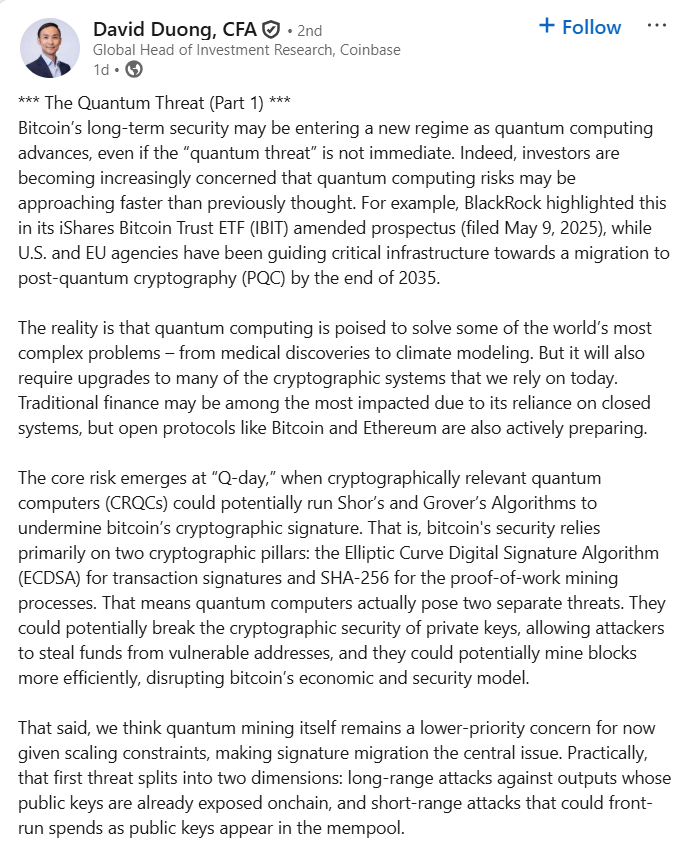
Quantum computing continues to be a hotly debated subject within the crypto community, primarily due to its potential to break existing cryptographic protocols. According to David Duong, Coinbase’s head of investment research, quantum computers may soon be capable of executing algorithms such as Shor’s and Grover’s, threatening the cryptographic signatures securing Bitcoin transactions.
“Bitcoin’s security fundamentally relies on two cryptographic elements: the Elliptic Curve Digital Signature Algorithm (ECDSA) for transaction authorization and SHA-256 for proof-of-work mining,” Duong explained. “Quantum computers could both compromise private key security and enhance mining capabilities, potentially destabilizing Bitcoin’s economic model.”
Mining and the Quantum Threat
Mining relies on computational power to solve complex mathematical problems, uniquely allowing miners to add blocks to the blockchain. Quantum computers, with their exponential processing power, could revolutionize this process. They may enable a single entity to more easily perform a 51% attack—controlling over half of the network’s mining power and manipulating the blockchain.
However, Duong suggests that the immediate concern is less about quantum mining and more about cryptographic signature migration, emphasizing that the technology is not yet capable of posing an imminent threat.
“Quantum mining remains a lower-priority issue given current constraints, but preparing for post-quantum cryptography is essential for future security,” said Duong. “Today’s quantum machines are far too small to break Bitcoin’s cryptography, but ongoing vigilance is crucial.”
Debate Over the Timeline
Skeptics like Adam Back argue the quantum threat is decades away, citing technological hurdles that must be overcome before quantum computers can pose a real threat. Conversely, figures like Charles Edwards warn that the threat could materialize sooner, urging the community to accelerate security measures to protect against future risks.
https://www.cryptobreaking.com/quantum-danger-to-bitcoin-more/?utm_source=blogger%20&utm_medium=social_auto&utm_campaign=Quantum%20Danger%20to%20Bitcoin:%20More%20Than%20Just%20Cold%20Wallets%20Under%20Threat%20
Comments
Post a Comment