
Regulatory clarity for digital assets remains a priority in Washington as the White House prepares a key meeting and Congress mulls the market-structure framework. On Jan. 29, 2026, SEC Chair Paul Atkins and CFTC Chair Mike Selig spoke on CNBC's Squawk Box about the CLARITY Act, in a segment linked here: discuss. The measure has cleared the House but is stalled in the Senate as Agriculture and Banking committees hash out provisions. The debate centers on stablecoin yields and how they should be regulated. Coinbase's withdrawal of support highlighted industry concerns. Atkins framed the dialogue as a path to a workable compromise, while Selig noted that, due to the GENIUS Act, stablecoin policy sits largely outside the agency’s remit, shifting the focus to securities and tokenized assets. A White House meeting with financial and crypto leaders on Monday adds momentum to the negotiations.
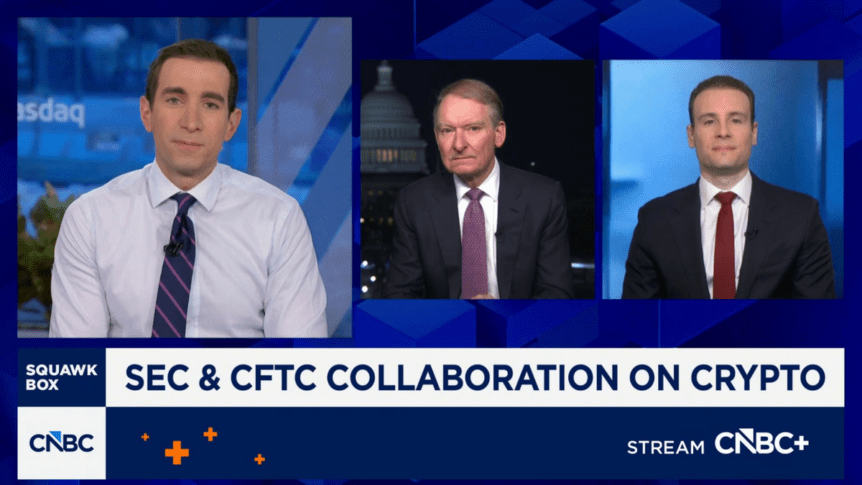
SEC Chair Paul Atkins (middle) and CFTC Chair Mike Selig (right) on CNBC’s Squawk Box. Source: CNBC
Key takeaways
- Regulators frame their role as advisory, signaling a collaborative but ultimately legislative-driven path to rulemaking on crypto, with the White House and Congress guiding the final framework.
- The CLARITY Act remains in limbo in the Senate after House passage, with Agriculture and Banking committees scrutinizing provisions that touch yield, custody, and supervisory jurisdiction.
- GENIUS Act’s July 2025 enactment has effectively placed stablecoin policy outside the reach of the SEC and CFTC, according to officials, shaping where responsibility lies as policymakers weigh securities versus non-securities classifications.
- Industry pushback surfaced when Coinbase withdrew support for the bill, underscoring concerns about how yield provisions would be treated under any final regime.
- A White House-hosted meeting on Monday aims to bridge gaps between bankers and crypto participants, signaling a push for a common regulatory language.
Market context: The regulatory process in Washington continues to influence liquidity, risk sentiment, and product development across the crypto sector, with participants awaiting a coherent set of rules that can be implemented without stifling innovation.
Why it matters
The evolving dialogue between regulators and lawmakers matters because it sets the tone for how market participants will operate in the near term. For investors and traders, clear rules reduce uncertainty around product design, disclosure standards, and risk management. Exchanges and custodians rely on predictable guidance to build compliant infrastructures, while developers exploring tokenized securities and other innovations need clarity on whether their use cases will be treated as securities or non-securities assets.
From a policy standpoint, the moment underscores a balancing act between investor protection and market efficiency. Regulators stress a willingness to engage once a broad consensus emerges, but the path to a final framework remains intricate: it involves reconciling the SEC’s and CFTC’s jurisdictions with newly enacted or proposed statutes, and it requires alignment with executive priorities outlined in White House meetings and Senate deliberations.
Observers also note that the final regulatory construct could resemble a mosaic rather than a single, sweeping regime. The emphasis on stablecoins — particularly the yields generated by certain stablecoin arrangements — has become a focal point of contention among traditional financial institutions and crypto firms alike. The ongoing debate, highlighted by the CNBC interview and committee hearings, illustrates how policy design will influence not just compliance costs but the pace and direction of product innovation in the sector.
What to watch next
- The White House meeting with banking and crypto executives on Monday, aimed at aligning industry expectations with policy objectives.
- Ongoing Senate Agriculture Committee discussions and potential amendments as lawmakers work toward a floor vote on the digital asset market structure bill.
- Any public statements or guidance from the SEC and CFTC following committee actions and interagency discussions.
- Industry responses and stakeholder advocacy as the yield provisions and regulatory boundaries for stablecoins are debated.
Sources & verification
- CNBC video: sec-cftc-chairs-on-crypto-regulation-we-can-codify-sensible-rules-of-the-road-for-the-asset-class.html
- Cointelegraph: live-senate-markup-crypto-market-structure-bill
- Cointelegraph: clarity-act-crypto-market-structure-coinbase-brian-armstrong
- Cointelegraph: stablecoin-genius-act-donald-trump-signing
- Cointelegraph: Trump banks crypto clarity market structure
- Cointelegraph: us-bank-lobby-aba-crypto-stablecoin-yields-priority-clarity-genius
Regulatory pathway and next steps
Key lawmakers and regulators remain cautious but engaged, recognizing that a final framework will require both bipartisanship and a careful division of responsibilities among federal agencies. The CLARITY Act’s fate in the Senate looms large, as does the White House's effort to broker consensus ahead of potential votes. In the near term, stakeholders should monitor the Monday meeting and any subsequent committee actions that refine the bill’s provisions, particularly around yield mechanics and the treatment of stablecoins within a wider regulatory taxonomy. The outcome could influence how quickly new market participants enter the space, how existing firms adjust their products, and how the broader investment community assesses risk in the evolving crypto landscape.
What the article changes for readers
For industry players, the piece highlights the ongoing tug-of-war between policy goals and market realities. For policymakers, it underscores the practical implications of jurisdictional choices and yield policy on innovation and consumer protection. And for observers, it provides a snapshot of how front-office discussions translate into legislative momentum or gridlock, shaping the trajectory of digital asset regulation in the United States.
https://www.cryptobreaking.com/sec-and-cftc-strike-a/?utm_source=blogger%20&utm_medium=social_auto&utm_campaign=SEC%20and%20CFTC%20Strike%20a%20Conciliatory%20Tone%20Ahead%20of%20CLARITY%20Act%20Talks%20
Comments
Post a Comment