
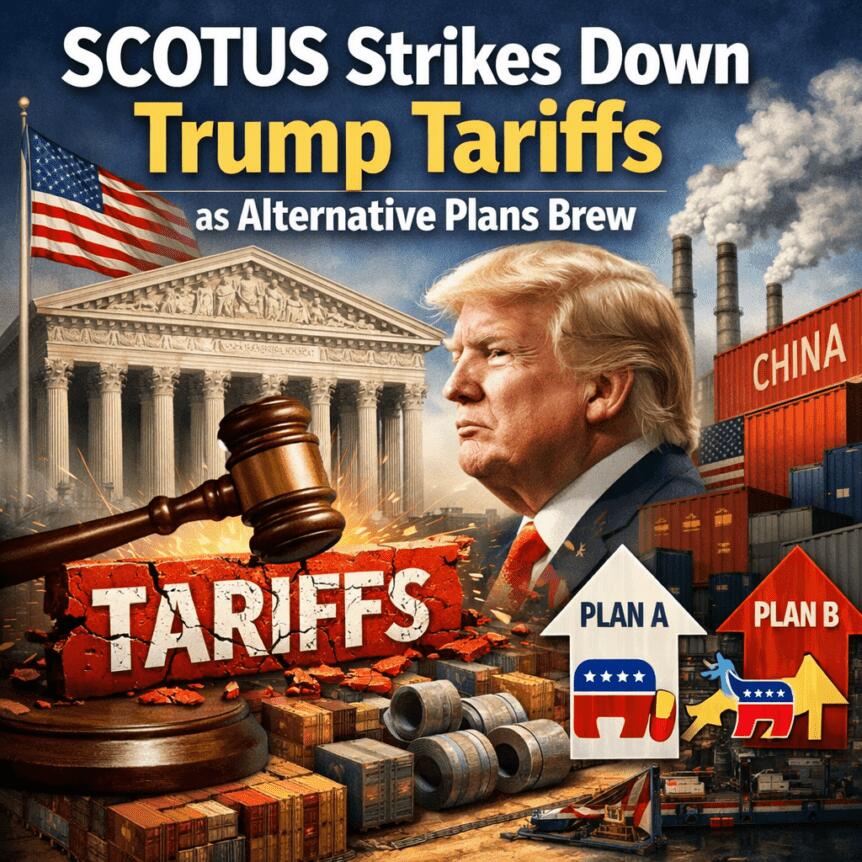
The Supreme Court’s decision on Friday sharply curtailed the executive branch’s authority to deploy tariffs under the International Emergency Economic Powers Act (IEEPA). In a 6-3 ruling, the justices concluded that the President lacks inherent power to impose broad tariffs under peacetime conditions, signaling a significant check on executive power in U.S. trade policy. The majority’s view was clear: IEEPA does not authorize tariffs at the scale seen in recent years, and the presidential interpretation of the statute extended beyond its legitimate reach. The ruling hinges on historical precedent and the breadth of authority claimed by the administration, suggesting a reevaluation of the tariff policy framework used during peacetime emergencies. The decision was issued on Friday, February 20, 2026, with the court emphasizing the statute’s limited scope.
“In IEEPA’s half-century of existence, no president has invoked the statute to impose any tariffs, let alone tariffs of this magnitude and scope. That ‘lack of historical precedent,’ coupled with the breadth of authority that the President now claims, suggests that the tariffs extend beyond the President’s ‘legitimate reach.’”
At issue was whether tariffs imposed as a means of addressing perceived national emergencies could be sustained under IEEPA. The court’s opinion rejected that premise, noting that the administration had not demonstrated a statutory basis strong enough to justify the breadth and scale of the measures in question. The decision, while narrow in its focus on statutory interpretation, carries broad implications for how future administrations might leverage tariff tools in times of perceived distress. The ruling’s central thrust is that IEEPA does not authorize sweeping tariff regimes, and the absence of a sustained, historically grounded precedent undermines the President’s justification for such measures.
Trump criticizes court, says he’ll get tariffs reinstated
Following the ruling, former President Donald Trump blasted the justices who voted to strike down the tariffs and signaled that the policy would persist through alternative channels. A report noted that he pledged to pursue reinstatement via other avenues, raising questions about what policy instruments could replace tariffs as a means to influence trade dynamics. The courtroom decision, contrasted with Trump’s rhetoric, underscores a broader political debate over how the United States should calibrate its use of trade tools in pursuit of fiscal and industrial goals.
Trump asserted that tariffs were a lever to address perceived imbalances with Canada, China, and Mexico, and he framed the decision as a setback for U.S. economic strategy. Critics argued that tariff policy risks provoking retaliatory actions, disrupting supply chains, and injecting volatility into already fragile macro conditions. The clash between judicial limits and executive ambitions has intensified scrutiny over the federal policy toolkit available to safeguard domestic industries while maintaining competitive leverage on the global stage.
Historically, the tariff discourse has had tangible spillovers across asset markets. In 2025, for example, the prospect or announcement of new tariffs sent shockwaves through equities and cryptocurrencies alike, amplifying uncertainty at a moment when investors were already grappling with a shifting macro backdrop. The prevailing narrative suggested that aggressive tariff posturing tended to compress risk sentiment and tilt asset pricing toward risk-off dynamics, a trend that reverberated across multiple sectors of the market.
As policy discourse continues, observers will watch for how the administration retools its approach. The White House has indicated it may pursue alternate mechanisms to achieve similar objectives, but the legal and economic costs of doing so remain a focal point for lawmakers, market participants, and international partners alike.
Trump claims tariffs could replace income tax, but crypto markets are paying the price
Earlier in the campaign cycle, Trump floated a controversial idea that tariff revenue could be used to replace federal income taxes, a proposition he described as potentially lowering the budget deficit. He argued that tariffs would substantially reduce taxes for many households, a claim that fed into a broader debate about the role of tariffs in fiscal policy. The implications for tax structures, consumer prices, and corporate planning were hotly contested among economists and policymakers, but the idea underscored how tariff revenue could be framed as a substitute for conventional taxation in certain scenarios.
Public disclosures and posts on social platforms reflected a broader narrative that tariff policy could be a transformative fiscal tool. While supporters argued that tariffs might boost domestic production and protect strategic industries, skeptics warned of distortions, higher consumer costs, and diminished global competitiveness. The policy rhetoric matched a volatile market environment where crypto assets, equities, and risk assets had shown sensitivity to tariff-related headlines and policy signals.
In practical terms, the tariff episode left crypto markets exposed to policy-driven risk. When tariffs targeted China in 2025, investors watched liquidity and volatility as leading indicators of how risk assets would respond. In that episode, Bitcoin (BTC) traded with noticeable swings, reflecting the broader interplay between regulatory expectations and appetite for alternative stores of value during periods of uncertainty. The price action mirrored the tension between policy risk, macro fundamentals, and the evolving sentiment around decentralized finance as a potential hedge against traditional financial channels.
Market commentators pointed to a combination of leverage, liquidity constraints, and sentiment factors as drivers of the crypto drawdown observed during tariff episodes. A notable pattern emerged: traders frequently viewed tariff announcements as catalysts for broader risk-off moves, reinforcing the idea that policy shocks can function as macro triggers for price movements across digital assets. In the wake of the latest ruling, traders and investors are parsing how policy space will evolve and what that means for risk parity, hedging strategies, and the resilience of crypto markets to regulatory shocks.
Market context
Market context: The ruling arrives amid a broader phase of regulatory scrutiny and ongoing debate about the role of tariffs in U.S. economic policy, which continues to ripple through crypto markets and risk assets as investors reassess policy risk and liquidity conditions.
Why it matters
The Supreme Court’s decision narrows the executive branch’s tariff toolkit, potentially altering the trajectory of U.S. trade policy in an era of rapid technological change and global supply-chain disruption. For investors, the ruling clarifies what authorities the administration can credibly rely on to shape market dynamics, reducing the likelihood of ad hoc tariff shocks that could surprise markets. For crypto market participants, the episode underscores the sensitivity of digital assets to macro policy developments and the need for resilience in volatile environments. Firms building in this space must consider how shifting tariff and regulatory landscapes could affect cross-border operations, energy pricing, and financial infrastructure decisions. Finally, the ruling adds to the ongoing discourse about the balance between national policy interventions and market-based mechanisms, a debate that will continue to influence capital flows and innovation in the crypto ecosystem.
In the near term, traders will be watching how the administration navigates alternatives to tariffs and whether Congress steps in to provide clearer statutory guardrails. The decision may also spur renewed attention on how the U.S. coordinates with its trading partners to establish a more predictable policy environment, an outcome that could stabilize investor expectations and reduce speculative volatility in volatile assets like cryptocurrencies.
What to watch next
- Clarification on any alternative measures the executive branch may pursue to influence trade, including potential regulatory or administrative actions.
- Legislative responses or bipartisan discussions that could shape the future use of tariffs or trade tools.
- Crypto market reactions to future tariff-related headlines and potential policy shifts, with attention to liquidity and volatility metrics.
- Ongoing court considerations or challenges related to the scope of executive powers in economic policy.
- Further official statements or documentation detailing the scope and limits of IEEPA in modern policy applications.
Sources & verification
- Official Supreme Court ruling: The ruling PDF provides the Court’s reasoning and the formal holding on IEEPA’s authority (https://www.supremecourt.gov/opinions/25pdf/24-1287_4gcj.pdf).
- Politico coverage of Trump’s reaction to the ruling (https://www.politico.com/news/2026/02/20/donald-trump-tariff-supreme-court-reaction-00791245?utm_medium=twitter&utm_source=dlvr.it).
- Cointelegraph reporting on tariff-related market dynamics and related policy debates (https://cointelegraph.com/news/trump-liberation-day-tariffs-markets-recession).
- Truth Social posts by Donald Trump referenced in coverage (https://truthsocial.com/@realDonaldTrump/posts/114410073592204291 and https://truthsocial.com/@realDonaldTrump/posts/115351840469973590).
- Market analysis linking tariff news to crypto sentiment (https://cointelegraph.com/news/crypto-traders-us-donald-trump-tariffs-market-decline-santiment).
Key details and implications for markets
Introduction to the core finding: The Supreme Court has curtailed the scope of presidential tariff powers under IEEPA, reinforcing a constitutional check on executive actions in times of economic strain. The ruling, while focused on statutory interpretation, triggers a broader recalibration of policy risk and how market participants price macro surprises. In the immediate aftermath, the president’s reception of the decision and his stated intention to pursue tariffs through other channels raised questions about the timing and nature of any forthcoming policy shifts. Investors will be watching for any formal policy proposals or regulatory steps that could reintroduce tariff pressures, particularly around cross-border trade with major partners.
What to watch next
- Dates for any anticipated policy proposals or regulatory actions outlining alternative tariff mechanisms.
- Potential shifts in congressional discussions that could frame future tariff authority or trade policy instruments.
- Monitoring of crypto market liquidity and volatility around new tariff-related announcements or debates.
Endnotes
Note: The coverage reflects developments reported across multiple outlets, including legal filings, political reporting, and market analysis linked above. The information should be verified against primary documents and official releases as policy positions evolve.
https://www.cryptobreaking.com/scotus-strikes-down-trump-tariffs/?utm_source=blogger%20&utm_medium=social_auto&utm_campaign=SCOTUS%20Strikes%20Down%20Trump%20Tariffs%20as%20Alternative%20Plans%20Brew%20
Comments
Post a Comment