
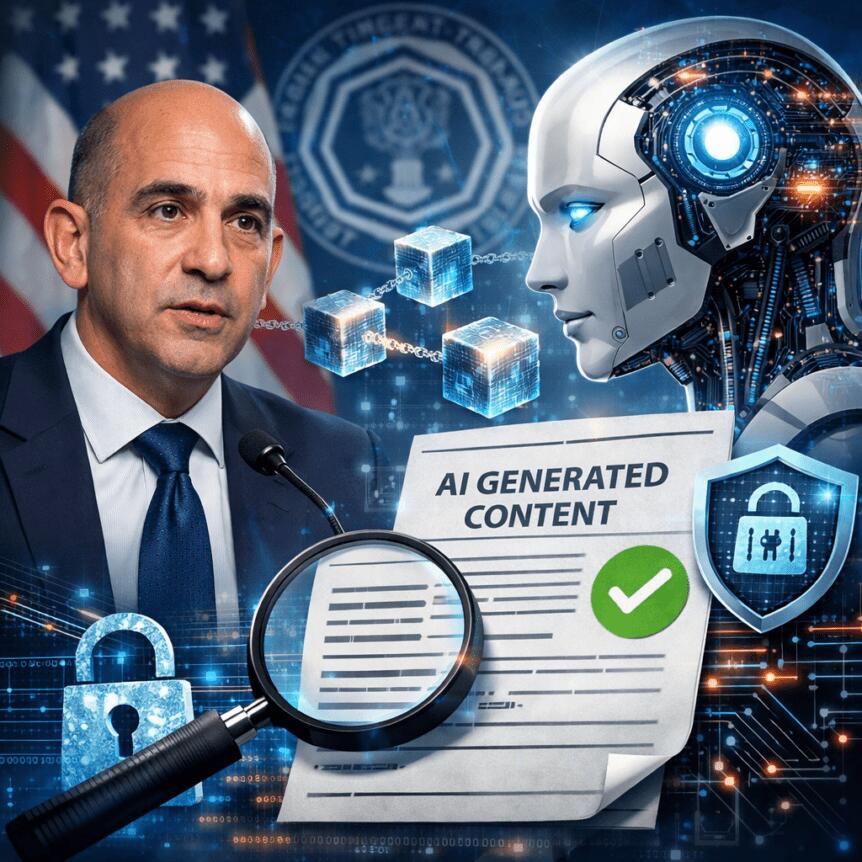
A top U.S. regulator says blockchain could become a core tool for verifying AI-generated media, arguing that distributed ledgers can help distinguish authentic content from synthetic outputs as concerns over misinformation grow. Speaking on The Pomp Podcast, Michael Selig, chair of the U.S. Commodity Futures Trading Commission (CFTC), described timestamping and unique identifiers for memes and AI-generated posts as a practical path to verification. He also stressed the importance of maintaining U.S. leadership in crypto, saying that “you can’t have AI without blockchain.”
When pressed about how regulators view AI agents in markets, Selig advocated a cautious, targeted approach. He cautioned against over-regulation that could dampen innovation and outlined a strategy that focuses on the actors participating in financial transactions, rather than imposing burdens on software developers who create the tools. The overarching aim, he said, is to ensure enforcement targets the right participants while regulators continue to study how AI models are used in trading.
Key takeaways
- Blockchain could be used to timestamp and identify AI-generated content, aiding validation of authenticity in a noisy information landscape.
- U.S. regulators favor regulating actors in financial markets rather than software developers, aiming for a “minimum effective dose” of regulation.
- Proof-of-personhood tools and related verification tech are being explored as a means to prove human backing for AI agents interacting online.
- Broader AI policy discussions in the U.S. include a push for a unified federal framework to avoid a patchwork of state rules that could hinder innovation.
Blockchain meets AI verification: the evolving playbook
The discussion situates blockchain at the center of a broader push to authenticate online content amid growing AI capabilities. Proponents point to the potential of verifiable timestamps and content identifiers on a public ledger to help users and markets distinguish real signals from AI-generated outputs. This line of thinking aligns with ongoing interest in provenance technologies that can preserve the integrity of information while limiting exposure to manipulated or misleading media.
In parallel, industry-driven efforts on proof-of-personhood are gaining attention as a possible backbone for AI interactions. World ID, developed by the startup World, aims to let users prove they are real humans without revealing sensitive data. The approach centers on cryptographic proofs and device-hosted biometrics, rather than centralized credential databases. While supporters argue this could curb automated abuse, critics raise privacy and coercion concerns that policymakers will need to weigh as these systems mature.
Another notable development is AgentKit, a toolkit unveiled earlier this year that enables AI agents to demonstrate a link to verified human backing while engaging with online services. It couples proof-of-personhood credentials with the x402 micropayments framework created by Coinbase and Cloudflare, enabling agents to pay for access while maintaining cryptographic attestations of human origin. The goal is to strike a balance between functional automation and accountable participation in digital ecosystems.
Tech leaders have long envisioned cryptographic approaches to content integrity. Ethereum co-founder Vitalik Buterin has proposed using zero-knowledge proofs and on-chain timestamps to validate how content is generated and distributed, without exposing private data. Such ideas echo a broader aspiration: to build verifiable, privacy-preserving rails for online discourse and market activity as AI becomes more embedded in everyday operations.
Regulatory backdrop: a national AI framework and the risk of a fragmented regime
The policy conversation in Washington has intensified around AI governance. In March, the White House signaled a move toward a unified federal AI framework, warning that a mosaic of state-level rules could hinder American innovation and global competitiveness. The administration’s framing suggests regulators want guardrails that protect consumers and markets while preserving incentives for technological advancement.
Within this landscape, the CFTC’s stance reflects a philosophy of precision regulation—addressing how market participants use AI tools and ensuring that enforcement targets the actors who cross lines, rather than stifling the underlying technologies. The agency is also closely watching how AI models operate in trading contexts, seeking to establish clear boundaries for permissible activities without throttling beneficial innovation.
Meanwhile, the broader crypto and AI ecosystems continue to intersect with debates about data sovereignty, privacy, and user control. The World ID approach and AgentKit illustrate a trend toward cryptographic identity and verifiable interaction as foundational layers for AI-enabled services. As policymakers weigh federal coordination against state experimentation, investors and builders will be watching for indications of regulatory clarity that could shape product strategies and risk management in the near term.
In sum, the conversation underscores a central question for markets: can verification technologies anchored in blockchain and cryptography deliver trusted AI interactions without compromising privacy or innovation? The answer may unfold through a combination of targeted enforcement, architectural shifts toward verifiable identities, and a balanced federal policy framework that harmonizes incentives with safeguards.
As these conversations advance, the next milestones to watch include any formal CFTC guidance on AI applications in regulated markets, new demonstrations of proof-of-personhood credentials in real-world services, and the regulatory community’s response to World ID and AgentKit-style initiatives as prototypes mature and scale.
https://www.cryptobreaking.com/cftc-chair-selig-blockchain-could/?utm_source=blogger%20&utm_medium=social_auto&utm_campaign=CFTC%20Chair%20Selig:%20Blockchain%20Could%20Verify%20AI-Generated%20Content%20
Comments
Post a Comment